iRobot Roomba 415X Review: A Daily Vac-and-Mop for Pet Homes
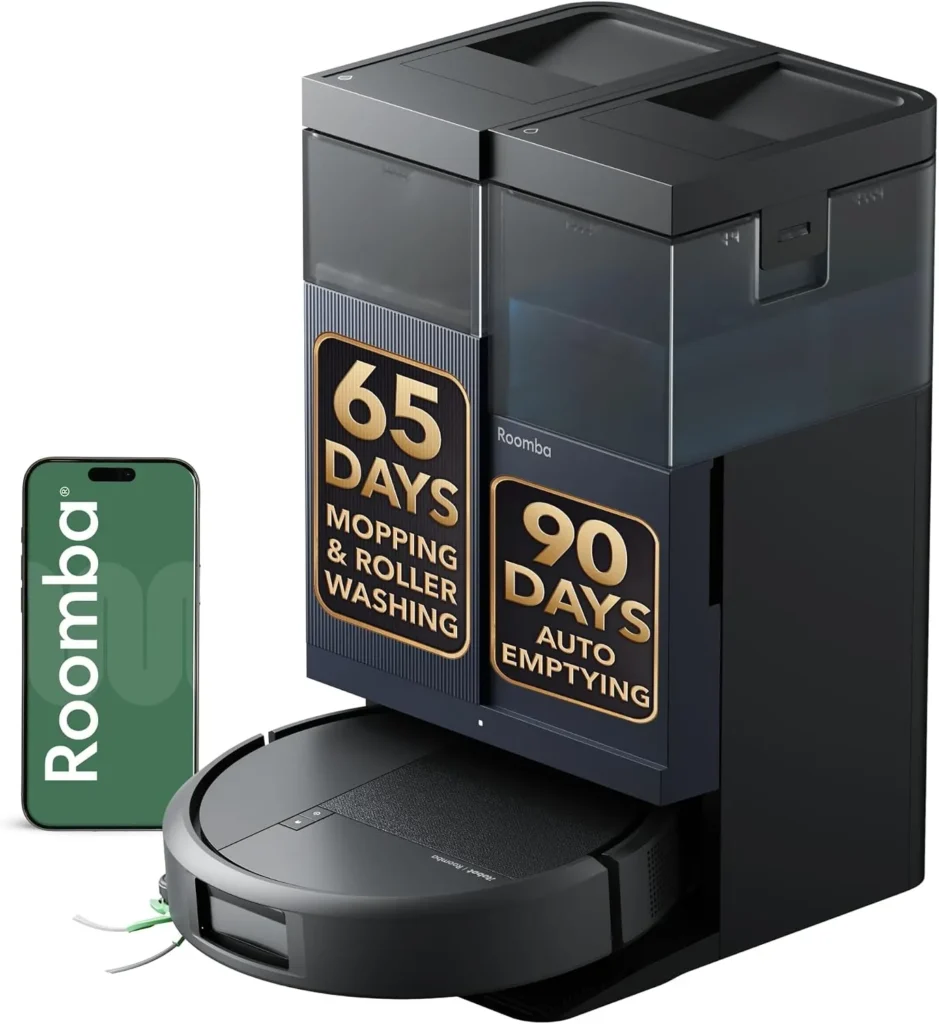
A hard-floor specialist for pet homes: it clears fur and grit daily, mops well for upkeep and hands the pad washing to its dock, provided the clip-on parts stay put.
Shedding season never ends in a house with two dogs. The iRobot Roomba 415X targets exactly that house, covering vacuuming and mopping in one trip before its AutoWash dock empties the bin and washes both spinning pads. The dock then dries them with warm air, and the robot lifts its pads over rugs to keep carpet dry. Its strength is hard flooring, where it keeps fur and grit under control with very little help from you. Ownership has rough edges, though. Its clip-on parts can come loose and setup demands a 2.4 GHz Wi-Fi network, while stray cables can still trip it up.
Hard floors in a shedding house
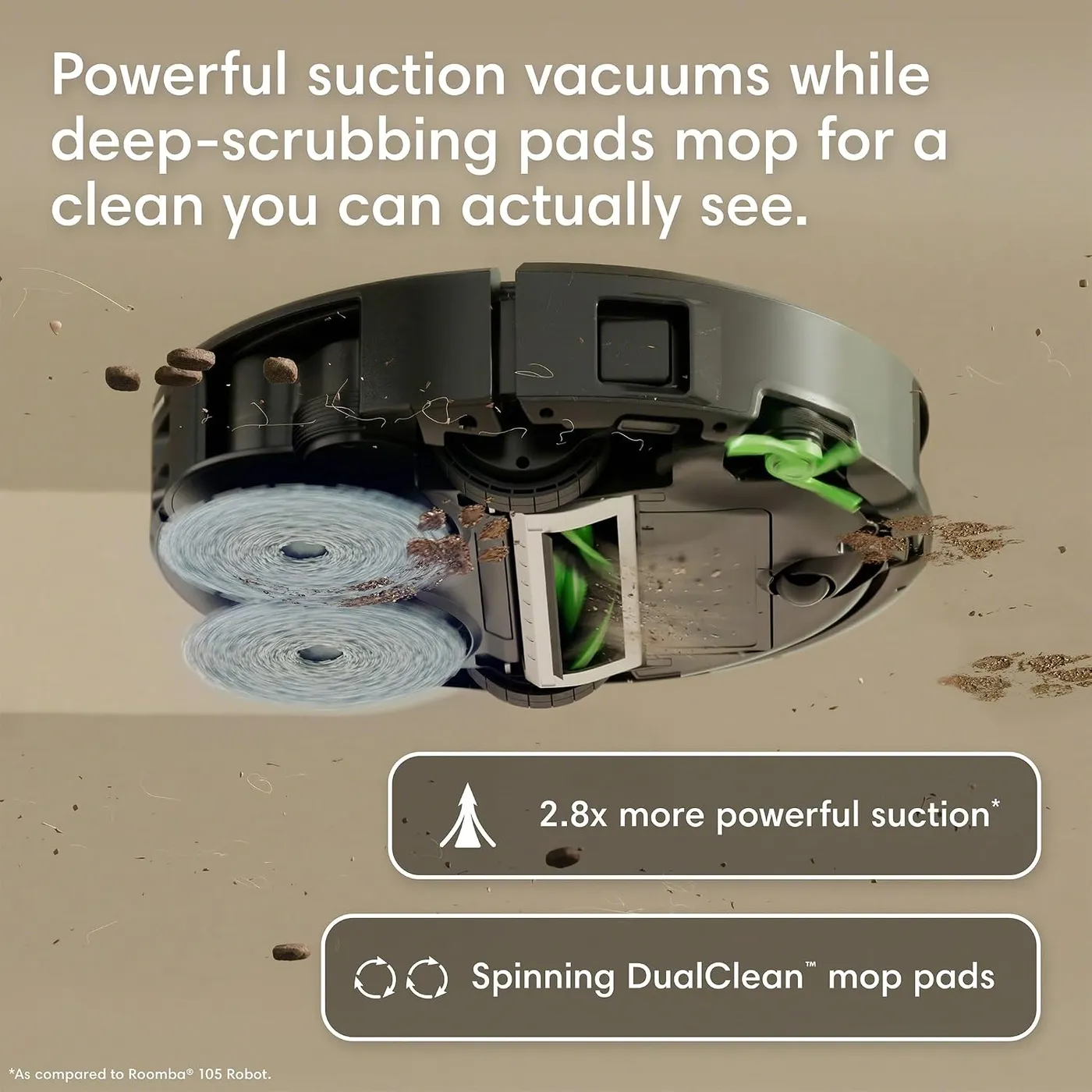
This is the job it does best. Sealed hardwood, vinyl plank and tile are its home ground, and on those floors it lifts grit, dust and pet hair cleanly. The iRobot Roomba 415X keeps pace even in a house with several large, heavy-shedding dogs when it runs every day.
Edges get attention too, since an extending edge-sweeping brush reaches into corners and along walls to pull the debris out.
According to iRobot's product page, its suction is 2.8 times that of the older Roomba Plus 405 Combo, while iRobot's retail listing quotes 20,000 Pa. Carpet Boost then adjusts suction on its own whenever the robot senses carpet below it.
Carpet comes up clean, often with the neat stripes of a freshly vacuumed floor. The robot climbs room thresholds and rolls onto carpet without fuss. Area rugs are its least predictable surface, since it picks up less from them than from bare floors. Now and then, a rug still hangs it up partway through a job.
The rubber brushes carry a tangle-free label, yet heavy shedding can still leave hair on the main brush and under its end caps. I'd follow iRobot's care chart, which asks for a weekly brush clean and a twice-weekly filter clean in pet homes.
A sharp map with a blind spot for cables
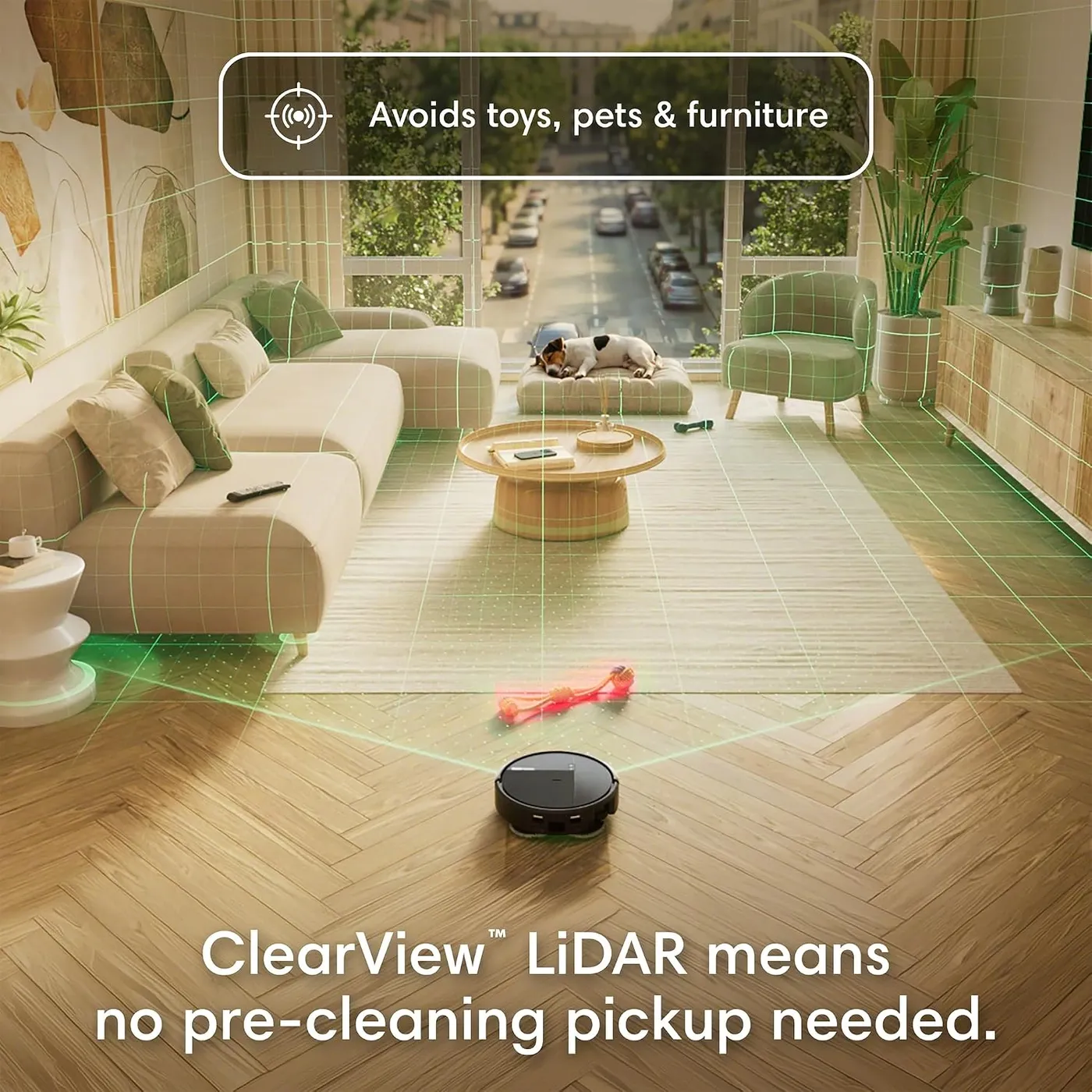
The map comes together quickly and accurately. ClearView LiDAR scans each floor, and the robot can store up to three maps, which lets it learn more than one level of a house. By iRobot's figure, mapping a 1,000 sq ft space takes nine minutes, and bigger floor plans need longer.
With the map saved, the app splits it into rooms, so you can send the iRobot Roomba 415X to the kitchen alone. You can set how each job cleans, and rooms that need more attention can get a second pass. A live map then shows what's done and what's left. Each run starts along the edges of a room and then covers the open floor in tidy rows. It threads around furniture with little bumping and returns to the dock on its own.
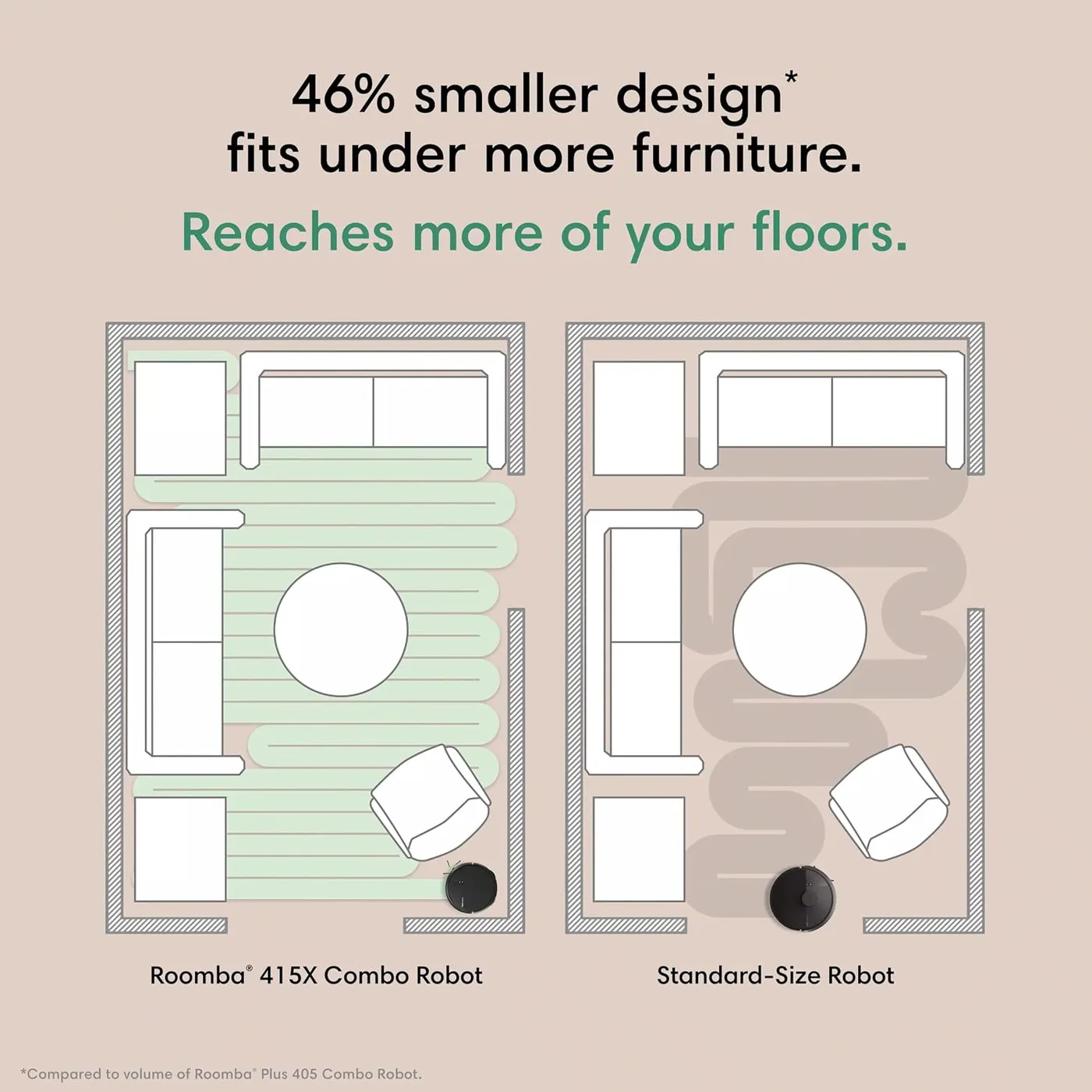
At 3.29 inches tall, it fits under a lot of sofas and other low furniture. That reach has a cost, since it can wedge itself into tight spots and wait there until you free it.
On cables, the marketing runs ahead of the robot. The product page says LiDAR and obstacle detection steer around cords, shoes and toys, so by that pitch nothing needs picking up first. Larger obstacles do get a wide berth. Charging cables and other cords are a different matter, because the brush can wind them up and jam. Even iRobot's manual tells you to clear clutter before each run, and that is the advice to follow.
The iRobot Roomba 415X as a mop
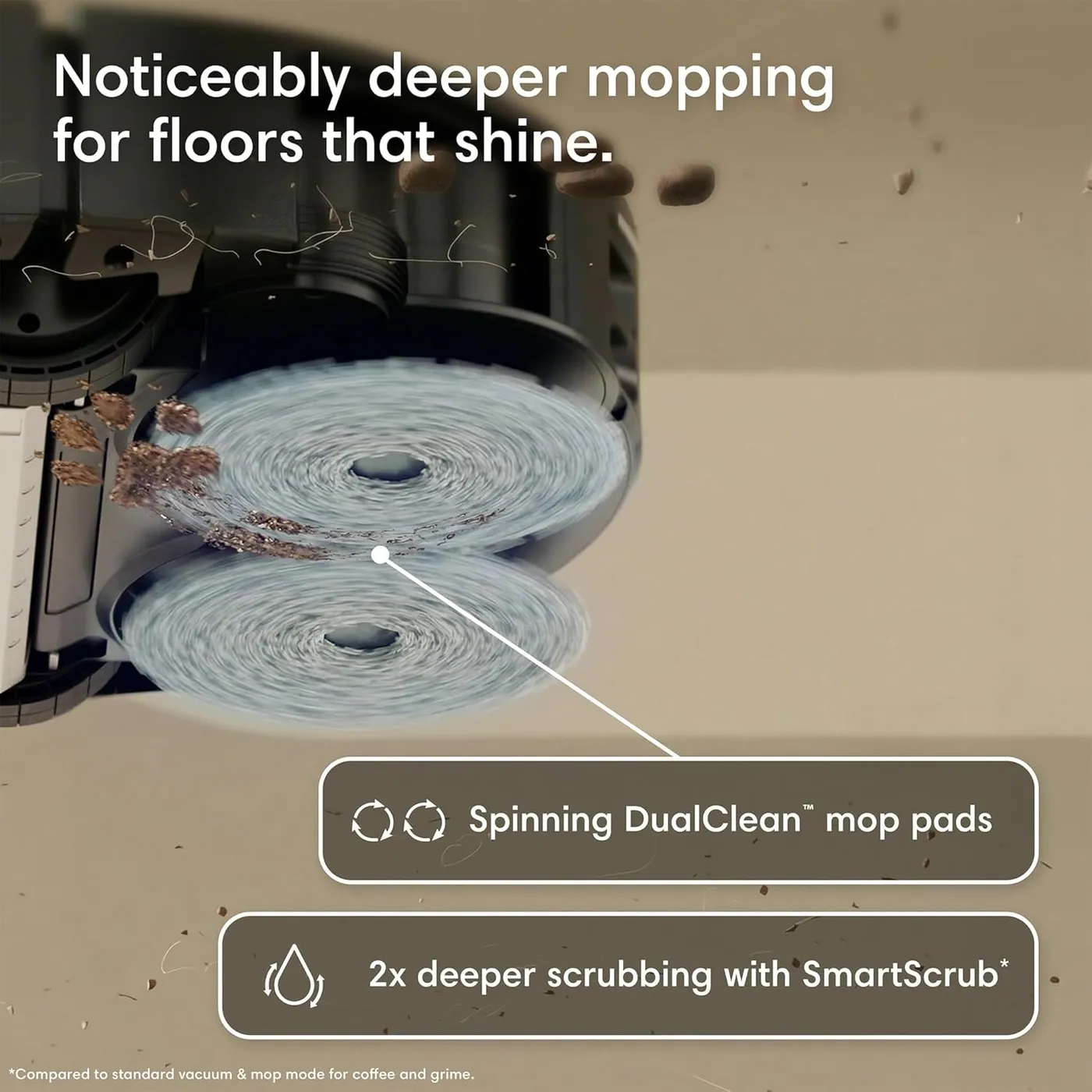
Two DualClean pads handle the mopping, spinning at 200 RPM. Switch on SmartScrub, and the robot scrubs back and forth over stubborn spots while pressing down, much as you would by hand. The product page also claims 2x deeper scrubbing than the robot's standard vacuum-and-mop mode, measured on coffee. An extension arm pushes the pads toward walls and into recessed edges and corners. According to iRobot, the extending design adds 18% more coverage than an unextended pad.
On sealed hard floors, the iRobot Roomba 415X makes a capable daily mop that keeps grime from building up. Partway through a mop job, the dock rinses the pads, which keeps one room's dirt out of the next. Dried-on spills expose its limits. The product page pitches SmartScrub at precisely that kind of mess, yet stuck-on spots still call for a hand mop.
Rugs stay dry. A carpet sensor lifts the pads 10 mm before the robot rolls onto a rug, which it then vacuums without mopping. The manual, more cautious than the product page, still suggests rolling up rugs in rooms you plan to mop, though in practice the sensor keeps them dry without that step.
That same manual warns against mopping unsealed hardwood and certain laminate or vinyl planks, since water can damage them. Set those rooms to vacuum only in the app.
Spinning pads are one way to mop a floor. The Roborock Qrevo Curv 2 Flow takes another, using a roller mop that rinses itself as it rolls. In contrast, the 415X sends its two pads back to the dock for washing. If mopping is your main job, weigh that design choice as heavily as any suction figure.
Wi-Fi setup and the Roomba Home app
Setup is the fussiest part of owning this robot vacuum. You need the Roomba Home app and a 2.4 GHz Wi-Fi network to finish it. A router that merges both bands under one network name is the usual snag. Splitting the bands for the first connection generally gets it online, though it can take several attempts.
Staying connected is a second hurdle, because the occasional unit keeps dropping off the network between runs, leaving the app unable to reach it.
Once the iRobot Roomba 415X is online, the app is easy to live with. Schedules are simple to set, and jobs can start while you're out. There are four modes: vacuum only, mop only, both at once, or vacuum first and then mop. Alexa, Siri and Google Assistant can start a clean by voice as well. Map editing is the clumsiest part, since room edits don't always save and the app can lag.
After setup, the robot runs without the phone if you want it to. The power button starts the default vacuum-and-mop run, and a double tap starts Spot Clean on a small square. Vacuum-only jobs and room choices still go through the app, which iRobot recommends for everyday control.
For privacy, iRobot says it encrypts stored data, has its security checked by third parties and lets you delete your data before passing the robot on.
Place the dock on a hard, level floor, out of direct sunlight and at least 4 feet from stairs. The manual sits under iRobot's Roomba Plus 410-419 Combo series, so search for that name rather than the 415X.
What 90 days of self-emptying covers
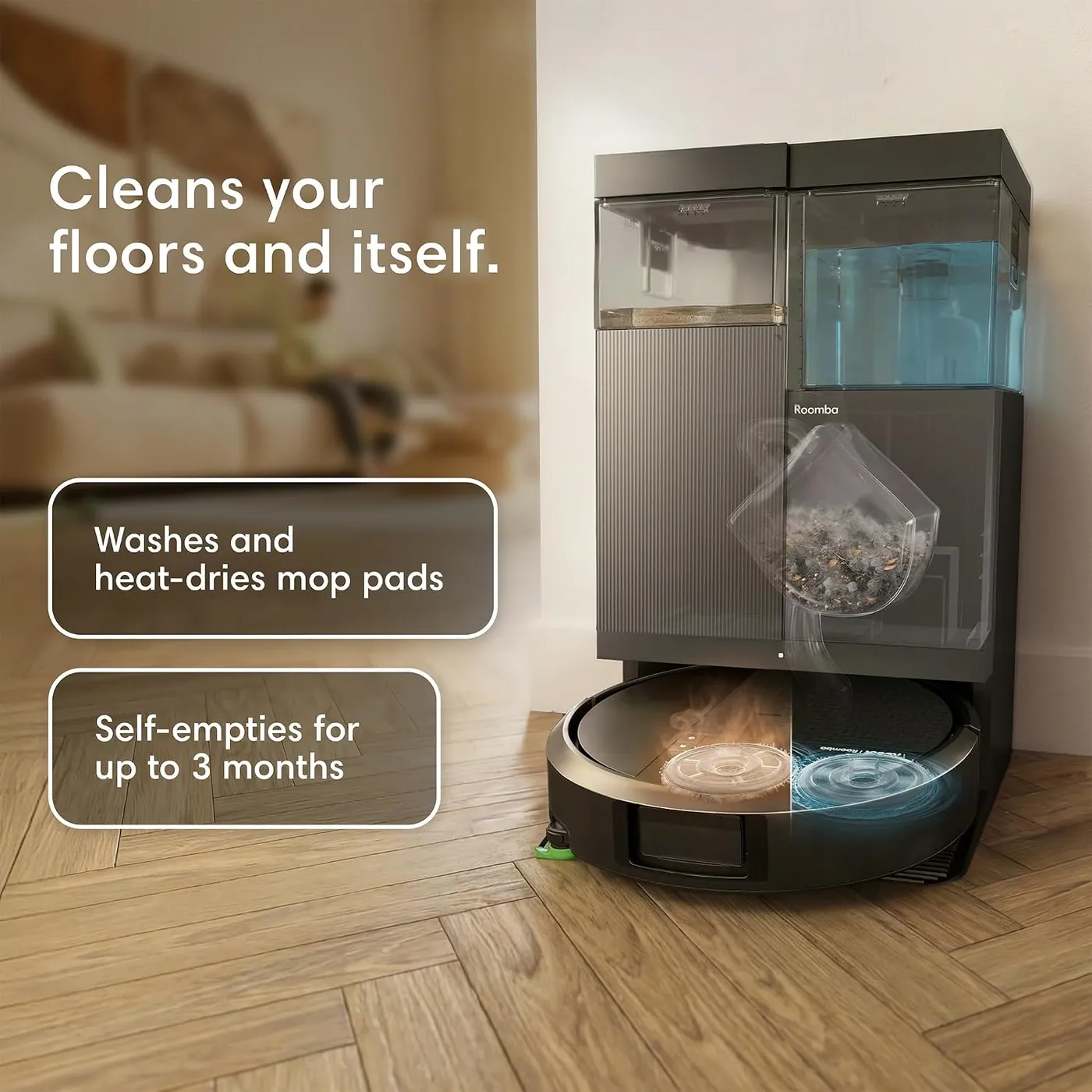
The dock carries the routine chores. After every run it empties the robot's bin into a sealed bag that, according to iRobot, traps 99% of allergens down to 0.7 microns. During mop jobs, the dock refills the robot's water and rinses the pads as needed. Once the run ends, it washes them again and heat-dries them at 113°F, by iRobot's figure. That drying can hum along for a few hours, and the app lets you choose the drying time. A self-cleaning cycle flushes accumulated debris out of the dock.
Read the 90-day figure closely. It describes the debris bag, which iRobot says can go up to three months between changes. The dock's light and the app both flag a full bag. Two bags come in the box, so order spares early.
Water runs on its own schedule, since the manual asks for a full clean tank and an empty dirty tank before each mop run. A clean tank covers only a handful of runs on a typical single floor.
Combined runs take time as well, because the iRobot Roomba 415X returns to rinse its pads again and again. A large floor plan can stretch a full job past a few hours. The 5,200 mAh battery is rarely the limit, since the robot recharges mid-job when needed and then finishes the rest.
Noise depends on the job: light vacuuming stays in the background, while the dock is plainly audible as it washes the pads. A full combined run is best scheduled for an empty house or behind a closed door.
Loose parts, shaky starts and routine care
The small parts let it down. The edge-sweeping brush clicks into place and the pad plates seat underneath, yet both can work loose mid-run and end up somewhere you have to hunt for them. Without a plate there's nowhere to fit a pad, so mopping waits until the missing piece turns up.
Spares have been harder to come by than they should be. Pads are easy to reorder, but replacement plates and brushes for the iRobot Roomba 415X have been scarce at times. The manual sends replacement-part requests to iRobot Customer Care. My advice is to buy a spare edge brush and plate set as soon as you can find one.
A minority of units arrive dead or fail within two months, while others begin stopping mid-run for no clear reason after a few good weeks. Give it heavy use from the first week, so any fault surfaces while the return window is still open.
Routine care is light but regular. Beyond the weekly brush and filter cleans, wipe the charging contacts every two weeks and the sensors once a month. Pads, filter and edge brush need replacing every three to six months, and at the dock you rinse the tanks as needed and clean the wash basin every two weeks. Fill the clean tank with plain water or iRobot's StayClean concentrate only, since unapproved solutions void the warranty. Hot water and vinegar are both out. A solid red light on the dock points to the bag, a tank or the wash basin. Our Roomba 415X troubleshooting guide walks through each of those jobs, from the first charge to a factory reset.
Pros: What we liked
- Pro: Lifts pet hair, grit and dust cleanly from sealed hardwood, vinyl plank and tile
- Pro: Dock empties the bin, rinses the pads mid-run and heat-dries them at 113°F
- Pro: Carpet sensing lifts the pads 10 mm, so rugs stay dry during combined runs
- Pro: Quick LiDAR mapping with room-by-room control and up to three saved maps
- Pro: Extending pads reach toward walls, corners and recessed edges
- Pro: Battery covers a typical floor, and the robot resumes where it stopped after recharging
Cons: What could be better
- Con: Pad plates and the edge brush can work loose mid-run, and spares have been hard to find
- Con: Setup needs the app and a 2.4 GHz network, and combined-band routers can need adjusting
- Con: Charging cables and other cords still need clearing before each run
- Con: A minority of units arrive faulty or start stopping mid-run within weeks
- Con: Mopping suits daily upkeep, but dried-on spills still need a hand and combined runs take hours
Best For
- Pet owners whose floors are mostly sealed hardwood, vinyl plank or tile
- Busy families who want the floors vacuumed and mopped on a daily schedule
- Anyone moving up from an older Roomba who wants mopping and a self-washing dock
- Homes with area rugs that need to stay dry while the hard floors get mopped
Not Ideal For
- Homes where charging cables and cords can't be cleared before each run
- Owners of unsealed hardwood or water-sensitive laminate who want it mopped
- Anyone who needs dried-on spills scrubbed away without a manual mop
| Specification | Details |
|---|---|
| Model number | G284020 |
| Robot size | 11.73 x 11.93 x 3.29 in (L x W x H) |
| Robot weight | 6.44 lb |
| Battery | 5,200 mAh NCM |
| Navigation | ClearView LiDAR, up to 3 saved maps |
| Suction | 2.8x the Roomba Plus 405 Combo (iRobot); 20,000 Pa (retail listing) |
| Mopping | DualClean spinning pads, 200 RPM, 10 mm lift on carpet |
| Dock | Auto-empty bag (up to 3 months), pad wash, 113°F heated pad dry |
| Wi-Fi | 2.4 GHz required |
| App and voice | Roomba Home app; Alexa, Siri, Google Assistant |
Alternatives Worth Considering
Final Verdict
The iRobot Roomba 415X is at its best in a pet home where hard floors dominate. Day after day it keeps fur and grit down and mops well enough for upkeep, while its dock handles the emptying, rinsing and drying. The friction sits at the edges. Setup on 2.4 GHz can take several tries, cables still need lifting and clip-on parts can go missing. For a busy house with dogs or cats, I'd buy it and build two small habits from day one. Clear the cords before each run, and look over the plates and brush after it.
Frequently Asked Questions
Does the 90-day self-emptying claim cover the water tanks?
The up-to-90-day figure is iRobot's claim for the debris bag. The manual asks for a full clean tank and an empty dirty tank before each mop run, so expect to refill and empty the water every few days on a typical floor.
Can I add floor cleaner to the clean water tank?
Use plain water or iRobot's StayClean Mopping Concentrate, two caps in the empty tank before filling it to the line. Skip vinegar and hot water, since iRobot's support page says vinegar causes corrosion and unapproved solutions void the warranty.
Is it safe to mop laminate or unsealed hardwood?
The manual advises against mopping unsealed hardwood and certain laminate or vinyl planks, because water can damage the flooring or the subfloor. Set those rooms to vacuum only in the Roomba Home app.
Can it run without the Roomba Home app?
Setup needs the app and a 2.4 GHz Wi-Fi network. After that, the power button starts a default vacuum-and-mop run and a double tap starts a Spot Clean, while vacuum-only runs, room choices and schedules go through the app.
What happens if a mop pad plate goes missing?
Without a plate there's nowhere to fit a pad, so mopping waits until it turns up or a replacement arrives. Spare plates have been scarce for this model, and the manual directs replacement-part requests to iRobot Customer Care.
How long does the first map take?
About nine minutes for a 1,000 sq ft space, by iRobot's figure. A larger or busier floor plan takes longer, and the robot can store up to three maps for different levels of a home.
The Verdict
A hard-floor specialist for pet homes: it clears fur and grit daily, mops well for upkeep and hands the pad washing to its dock, provided the clip-on parts stay put.