eufy E25 Review: HydroJet Mopping and Pet-Hair Pickup
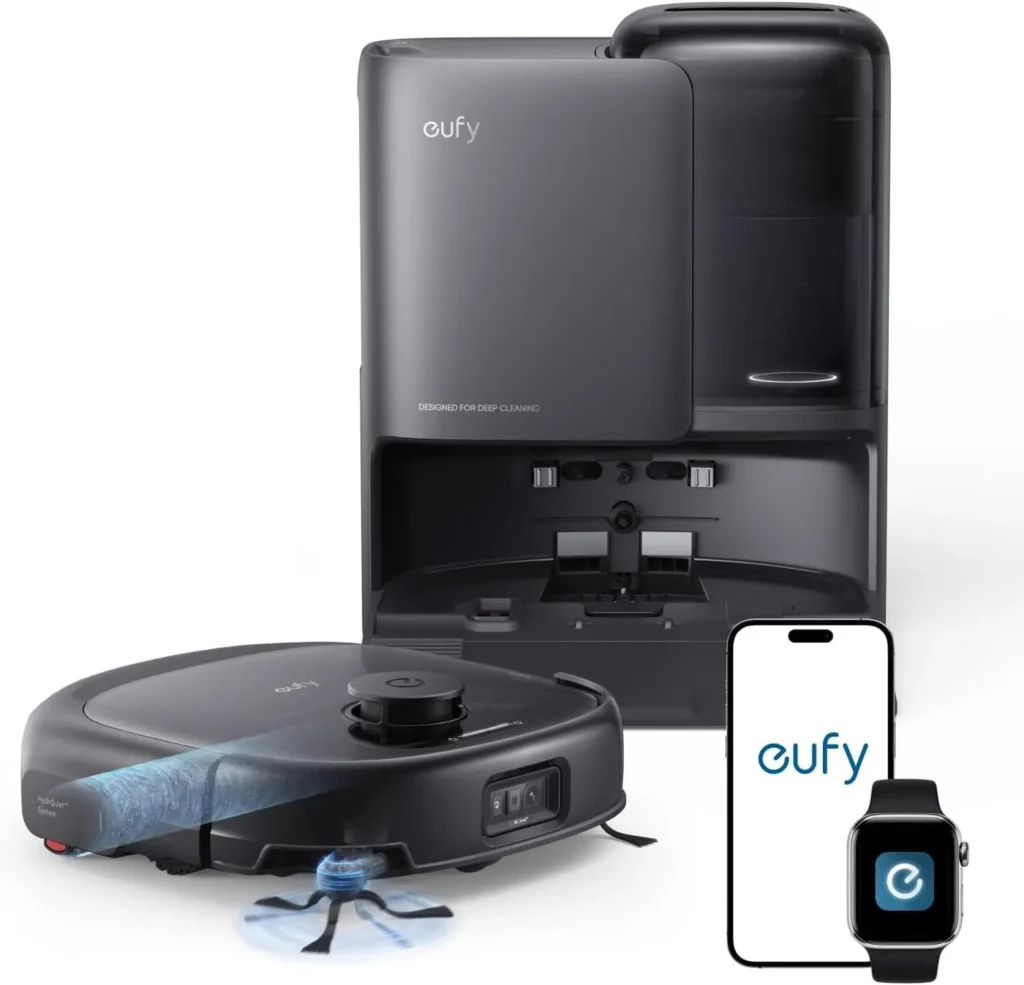
Strong pet-hair pickup and a HydroJet roller that leaves a freshly washed finish make this a quiet, thorough hard-floor cleaner, provided its dock gets a weekly rinse.
The eufy E25 goes after a familiar mess: shed hair and everyday grime on wood, tile and vinyl. By and large, it succeeds. Fur comes up thoroughly, and the HydroJet roller mops during that same run, leaving hard floors with a just-washed look. The robot itself also runs pleasantly quiet. Instead, the noise and the leftover chores gather at the dock, where the emptying cycle is loud and a tray and a dirty-water tank still need rinsing by hand.
Fur, grit and the HydroJet roller on hard floors
Hair pickup comes first, and the E25 gets it right. Shed dog and cat hair lifts cleanly from wood, tile and vinyl plank, along with tracked-in dirt, even in homes with more than one heavy shedder. Wall lines and corners end up clean as well, with help from the CornerRover arm. In eufy's description, that arm extends to scrub along baseboards, furniture legs and tight corners.
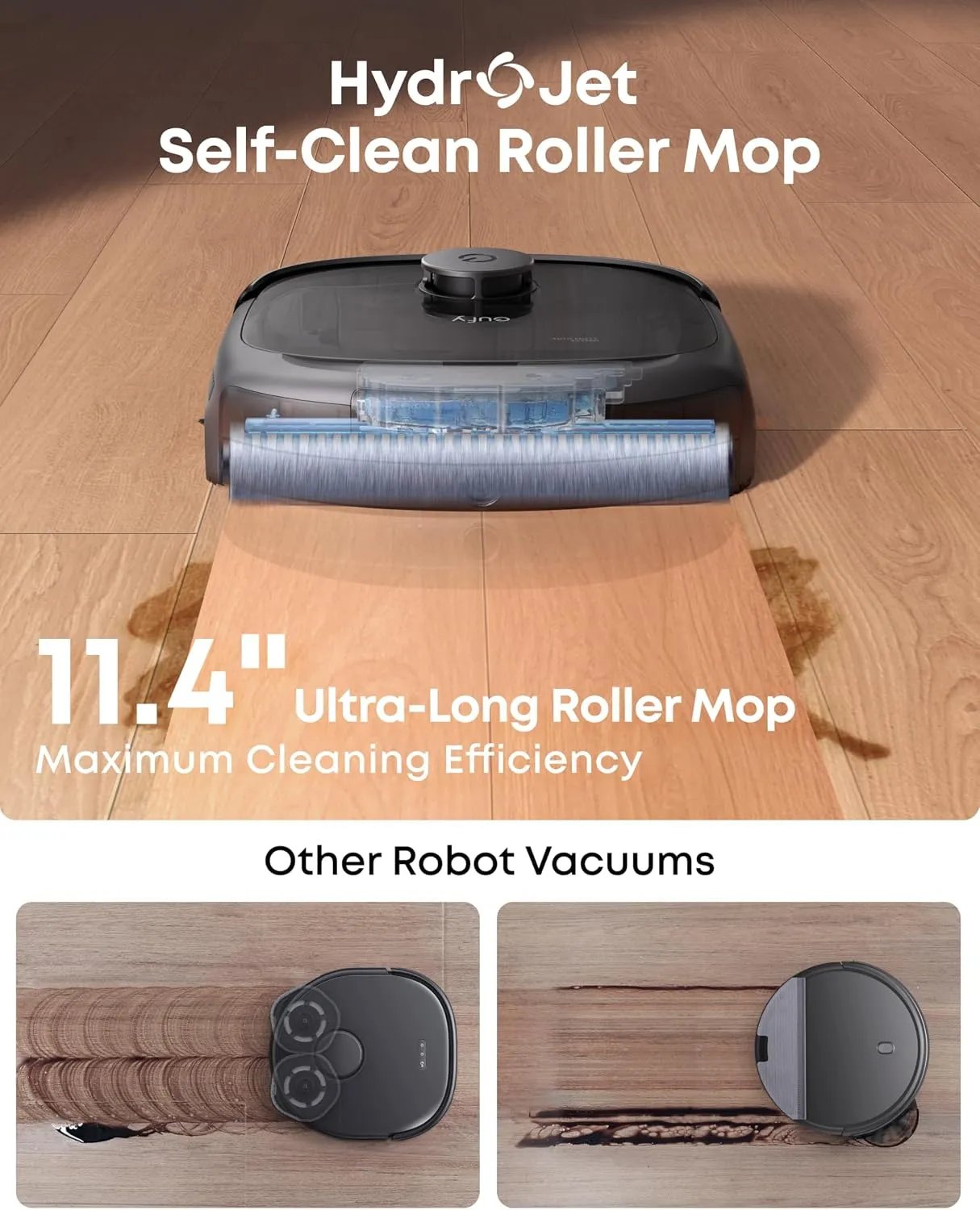
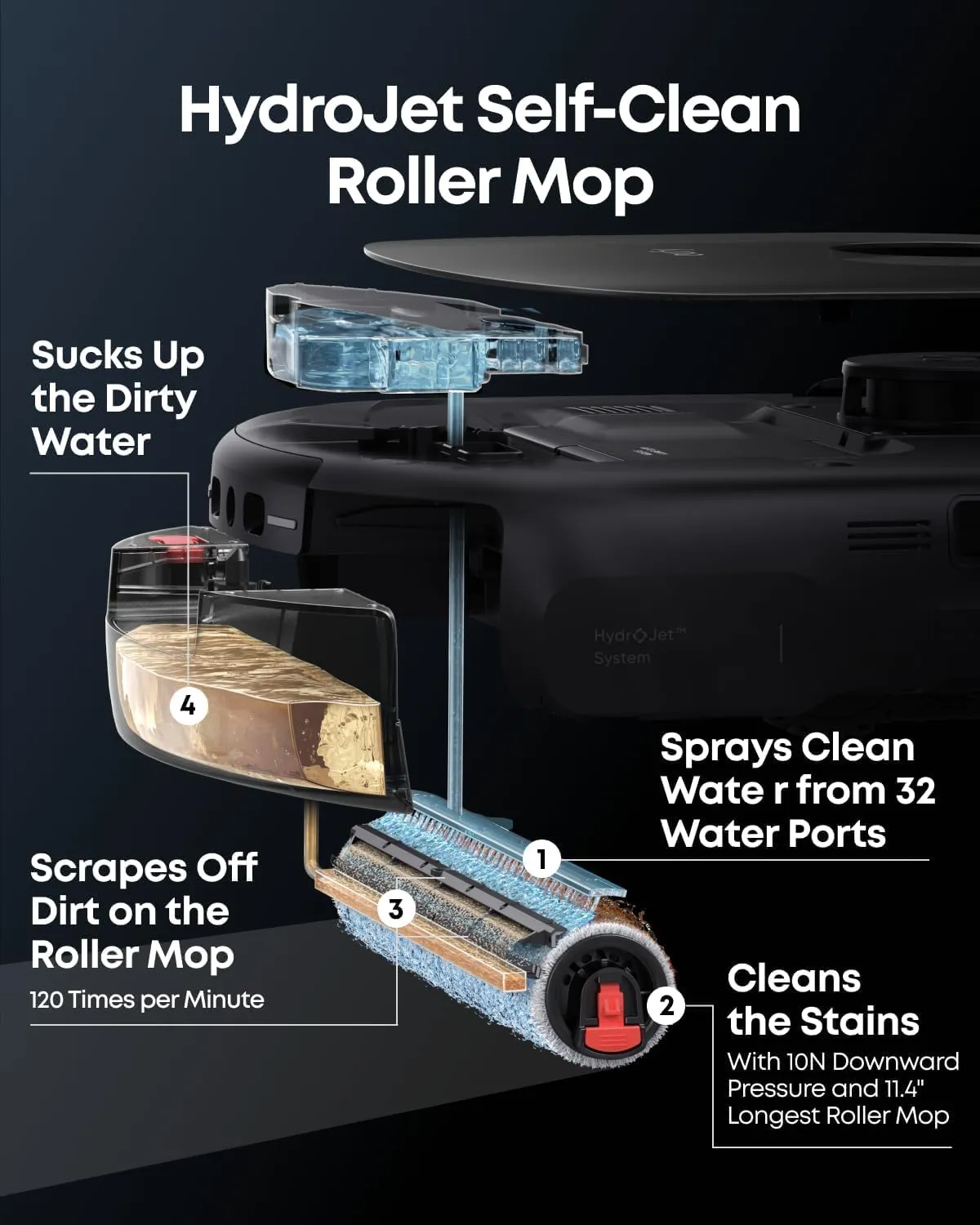
Mopping is the bigger draw, and it happens in the same run as the vacuuming. According to eufy's product page, the HydroJet roller cleans itself 120 times a minute, so the mop stays fresh. On hard floors, the payoff shows: after a combined run, the floor looks newly washed. For me, that finish is the strongest argument for the eufy E25.
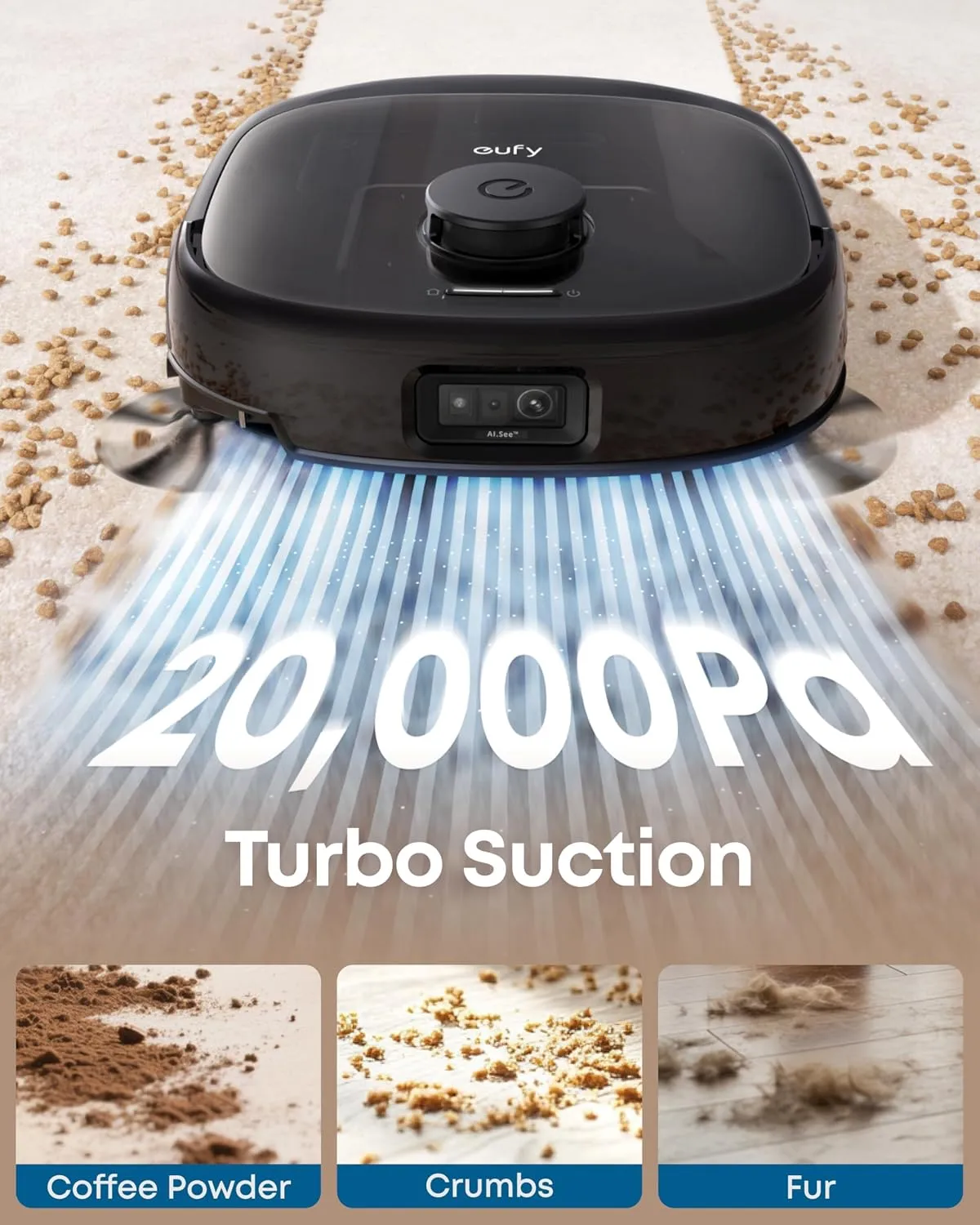
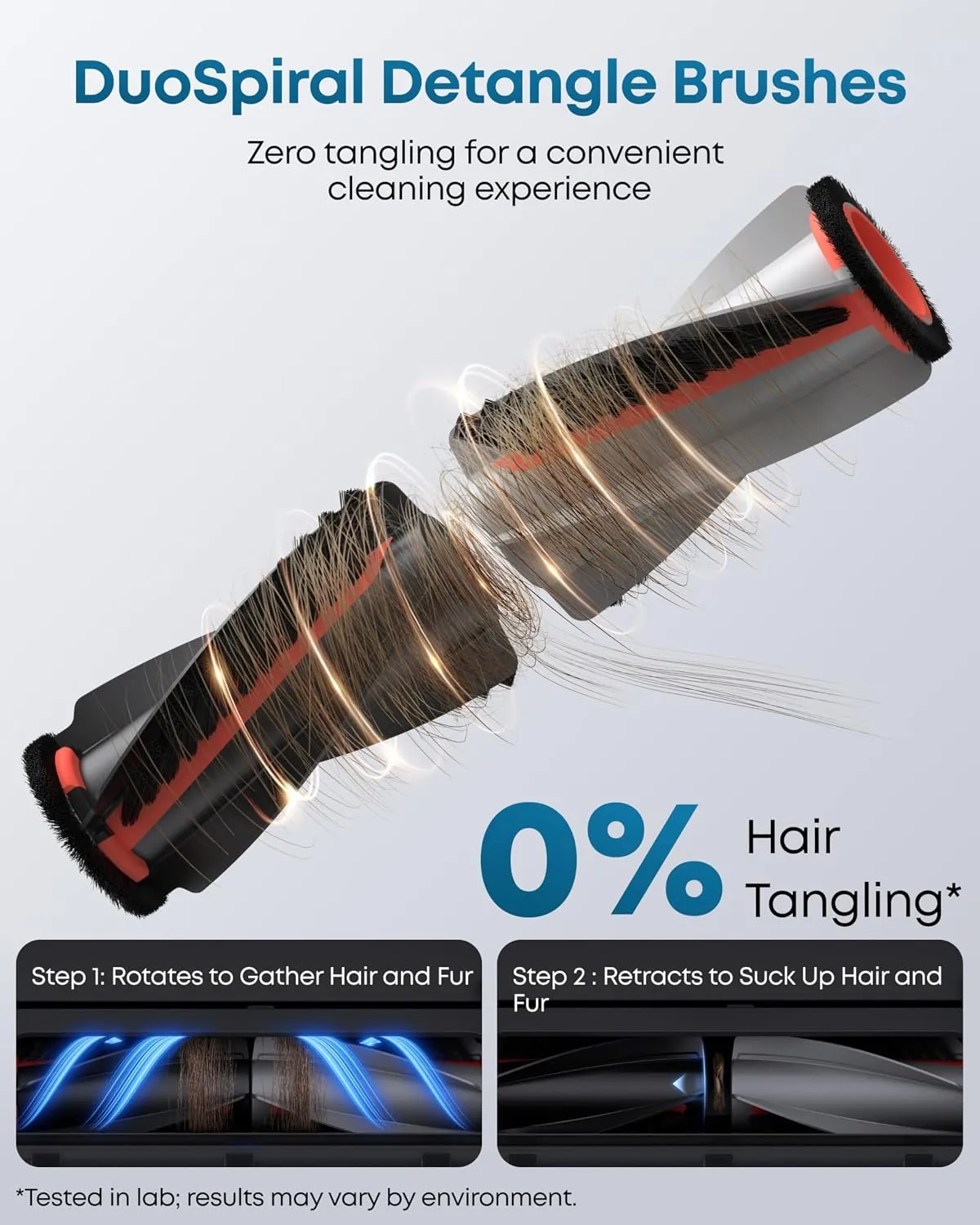
Underneath, two DuoSpiral rolling brushes work the floor, and eufy designed them to stop hair from tangling. The side brush and CornerRover arm are less forgiving: the manual warns that hair wraps around them easily. The suction figure eufy quotes is 20,000 Pa. For homes with pets or children, eufy's FAQ suggests Turbo or Max suction, plus an empty frequency of 15 or 30 minutes in the app.
Stains, streaks and the detergent cartridge
Set-in stains are where the eufy E25 struggles. Dried coffee, sticky spills and ground-in dirt tend to survive a pass, even though eufy's listing says the roller removes tough stains like coffee and sauce. Streaks and a thin film can also appear at times. To eufy's credit, its FAQ warns that early runs may streak while the robot lifts thick dust from under furniture. That streaking, it says, fades with repeat cleaning.
A few of eufy's own tips help, starting with a vacuum-only pass before the first mop to clear that dust. The app's three water levels also let you raise the flow where a floor needs it. For stubborn spots, eufy suggests mopping the area twice and switching on Dirty Spot Cleaning, which detects stains such as coffee spills and gives them a deeper mop. I'd still keep a hand mop within reach.
Of everything in the mopping system, the detergent adds the least. The station doses eufy's Floor Cleaner automatically, and eufy says one cartridge lasts up to six months. The mopping FAQ asks for that official formula. Budget for refills along with dust bags, filters and the new roller the manual schedules every three to six months. Yet the formula itself does little for the stains above, so the roller and the water level do the real work.
Having the dosing built in is still a convenience. The Dreame L40 Ultra Gen 2 needs a separate module before its dock can dose detergent. By contrast, the eufy E25's station takes eufy's Floor Cleaner cartridge from day one. Mop design differs too, with the Dreame swinging a pad out toward the wall and the E25 pairing a roller with its CornerRover arm.
Rugs, door sills and carpet modes
Results vary more on rugs. By eufy's listing figures, the robot climbs thresholds up to 21 mm and lifts its mop 10.8 mm over carpet. Low transitions usually pass without trouble, and it switches between mopping and vacuuming at a rug's edge on its own. Rug corners, curled edges and tassels are less reliable, as they can stall the robot or wrap around its brushes.
The manual's advice is to fold tasseled edges under and skip high-pile rugs or any rug thicker than 21 mm. For short pile, eufy's FAQ points to Vacuum Only mode, which raises the mop module when the robot senses carpet. Medium and long pile call for Carpet Avoidance instead. Dark carpets may not register at all, so eufy suggests a no-go zone around them, while Boost IQ raises suction on carpet automatically.
Carpet-heavy homes get less from the eufy E25, because its best work happens on hard floors. In a home carpeted wall to wall, I suspect the roller would spend much of each run lifted out of the way.
Cords, low furniture and no-go zones
On open floor, navigation is a strength. A LiDAR sensor maps the home quickly and accurately, while AI.See pairs an RGB camera with an LED light to steer the robot around furniture, shoes and toys. AI.See is a toggle in the app, and eufy's FAQ advises switching it on.
Cables and other thin objects are a different case, and eufy itself says the robot can occasionally miss them along with tiny toys. The manual asks for cords, socks and similar items to come off the floor before a run. It also warns that the robot may climb anything lower than 21 mm, so flat clutter deserves a quick check.
Height sets another limit, since the robot stands 111 mm tall with its LiDAR housing on top, per the manual. For furniture lower than 116 mm, eufy's FAQ recommends no-go zones. In practice, that keeps the eufy E25 out from under some low sofas and tables. Mirrors and glass doors can confuse the LiDAR too, and eufy's support pages prescribe the same no-go fix.
Left to itself, the robot will keep pushing at a shut door or a makeshift barrier, so closed doors call for the same approach. The manual says no-go zones in the app remove the need for physical barriers, and they're worth drawing early.
Maps, rooms and the app's learning curve
Getting started is easy. The app divides the first map into rooms automatically, and from there you can name rooms, draw cleaning zones and add no-go or no-mop areas. Schedules can cover any day of the week. The robot also remembers up to five floor plans and switches between them on its own, by eufy's account.
Learning the app itself takes longer, and it can feel fiddly at first. Useful options such as AI.See and the dirt-detection settings wait in the menus for you to switch them on. Once you've set a routine, though, room and zone control becomes easy to live with. The app also tracks when parts need attention, and its Accessory Store keeps replacements a few taps away.
Per eufy's listing, the robot connects over 2.4 GHz Wi-Fi only. Firmware updates can install automatically in the early morning once Auto Upgrade is on. Voice control works with Alexa, Google Assistant and Siri. According to eufy's support pages, the eufy E25 also supports Matter, and the eufy Clean app can connect it to Apple HomeKit. Each robot registers to one eufy account, though the app can share access with family members in the same country.
When to schedule the eufy E25
Timing comes down to the dock. A robot vacuum saves the most time when it can run while the house is busy or asleep. Out on the floor, the E25 rarely gets in the way, and it runs quiet enough for overnight cleaning on another level or behind a closed bedroom door. The dock is another story, since it gets loud while it empties the bin.
Evenings are what Do Not Disturb is for. During that window, the manual says, the robot stays silent while automatic dust collection and voice prompts switch off. Keep scheduled cleans outside it, though, because eufy's support pages warn that an overlap may skip dust collection and hurt the result. Daytime runs while the house is empty suit the eufy E25 best.
Battery life is rarely the bottleneck, with the manual listing 126 minutes of vacuuming and mopping at standard suction. On its quietest setting, that rises to 145 minutes, and a full charge takes 3.5 hours. A typical single floor gets done in one go, while a larger home may see the robot top up at the dock and then finish the job. For big floor plans, eufy's FAQ also suggests switching on auto-return cleaning in the app.
Station chores, clogs and early faults
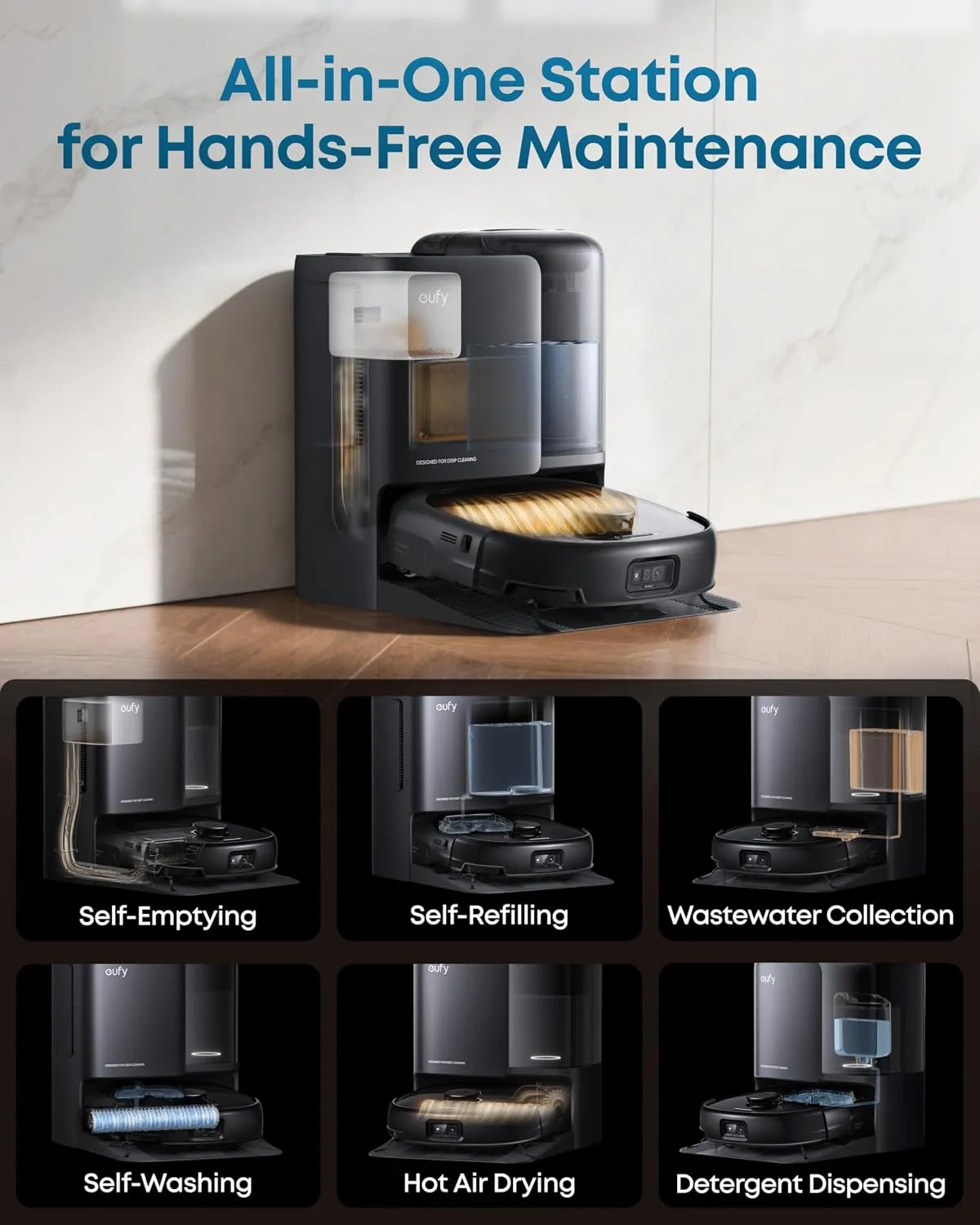
Day to day, the station does the dirty work. It empties the robot into a 3-liter bag that eufy says lasts up to 75 days, then washes the roller and dries it with warm air. To keep odors away, the manual recommends Standard Drying after every mopping session. Clean water comes from a 2.5-liter tank, while waste water goes into a 1.8-liter one. On long jobs, the robot also returns mid-run to rinse its roller, so later rooms get a clean mop.
Some chores stay manual, starting with the dirty-water tank, which the manual says to empty and clean every week. The cleaning tray needs a rinse every two weeks, and the robot's dustbin and filter need clearing weekly. Left longer, the tank and tray turn grimy, and some water-handling parts are awkward to reach. Heavy shedding adds a job: hair can jam the onboard bin so the dock can't empty it until you clear it by hand.
Reliability is the bigger concern, since a minority of units have failed within their first months. Everyday errors are a separate matter: a steady or fast-flashing red light on the robot, or a steady red one on the dock, signals one, and the app explains the fix. For those, our eufy E25 troubleshooting guide sorts each fault into the water side or the dust side.
Pros: What we liked
- Pro: Lifts shed dog and cat hair from wood, tile and vinyl, even with more than one heavy shedder
- Pro: HydroJet roller leaves hard floors looking newly washed after a combined vacuum-and-mop run
- Pro: Quiet enough on the floor for overnight runs on another level or behind a closed door
- Pro: Quick, accurate LiDAR mapping with rooms, zones, no-go areas and weekly schedules in the app
- Pro: Edges and corners end up clean, helped by the extending CornerRover arm
- Pro: Station empties the bin, washes and dries the roller, refills water and doses detergent on its own
Cons: What could be better
- Con: A minority of units have failed within their first few months
- Con: The dock is loud while it empties the bin, so it pays to time runs for an empty house
- Con: Dirty-water tank and cleaning tray need hand rinsing, and heavy shedding can jam the onboard bin
- Con: Dried, sticky stains and ground-in dirt often survive, and streaks can appear on early runs
- Con: Rug edges, loose cords and furniture under 116 mm call for tidying or no-go zones before runs
Best For
- Pet owners whose floors are mostly wood, tile or vinyl
- Busy homes that want vacuuming and mopping done daily with little hands-on effort
- First-time robot buyers who can spend an evening learning the app
Not Ideal For
- Homes that are mostly carpet, where the roller mop has little to do
- Anyone hoping a robot will lift dried or sticky stains without a hand mop
- Owners who can't keep up with weekly tank and tray rinses at the dock
| Specification | Details |
|---|---|
| Suction | 20,000 Pa (eufy rating) |
| Mop type | HydroJet rolling mop |
| Navigation | LiDAR with AI.See RGB camera and LED |
| Run time, vacuum and mop | 145 min (Quiet), 126 min (Standard), 114 min (Max) |
| Charging time | 3.5 hours |
| Robot size and weight | 346 x 327 x 111 mm, 11.46 lb |
| Station size and weight | 369 x 461 x 436 mm, 15.92 lb |
| Station tanks and bag | 2.5 L clean water, 1.8 L dirty water, 3 L dust bag |
| Climbing and mop lift | 21 mm thresholds, 10.8 mm mop lift |
| Wi-Fi | 2.4 GHz only |
Alternatives Worth Considering
Final Verdict
On mostly hard floors with pets in the house, the eufy E25 gets the daily work right. Hair comes up, the roller leaves floors looking washed and the robot keeps its noise down. What it asks in return happens at the dock: loud emptying, plus a tray and tank to rinse often. At premium-tier money, those are real costs. Carpet-heavy homes, and anyone hoping to retire the hand mop, should weigh them first. For wood, tile and vinyl in a house that sheds, I'd take that trade for floors that stay presentable between deep cleans.
Frequently Asked Questions
How does the E25 differ from the eufy E28?
The E28 adds a Portable Deep Cleaner, which the E25 lacks, according to eufy's comparison table. Otherwise that table lists the same suction, mop type, run time and robot size for both.
Which carpet mode suits short-pile and thicker rugs?
For short pile, eufy's FAQ recommends Vacuum Only mode, which raises the mop module when the robot detects carpet. Medium and long pile suit Carpet Avoidance. Dark rugs may go undetected, so a no-go zone is the safer choice for them.
Can the dock stay quiet through the night?
Yes. During the Do Not Disturb window set in the app, the manual says automatic dust collection and voice prompts switch off. Keep scheduled cleans outside that window, since eufy's support pages note that an overlap may skip dust collection.
Will it stop at the top of the stairs?
Usually. The manual says its drop sensors prevent falls in most cases but work less well when dirty or on carpeted or reflective floors. For extra safety, the manual recommends a physical barrier or a no-go zone, and eufy's FAQ singles out dark-colored stairs.
Which floor cleaner goes in the dock?
The station doses eufy's own Floor Cleaner from a cartridge, and one comes in the box. Its mopping FAQ calls for that official formula with the automatic dispenser switched on, and eufy says one cartridge lasts up to six months.
How often do the E25's parts need replacing?
The manual's schedule puts a new dust bag every three months, or sooner when the app prompts. The roller mop, filter, side brush and brush guard follow every three to six months, while the rolling brushes and the station's filter valve assembly last about six months.
The Verdict
Strong pet-hair pickup and a HydroJet roller that leaves a freshly washed finish make this a quiet, thorough hard-floor cleaner, provided its dock gets a weekly rinse.