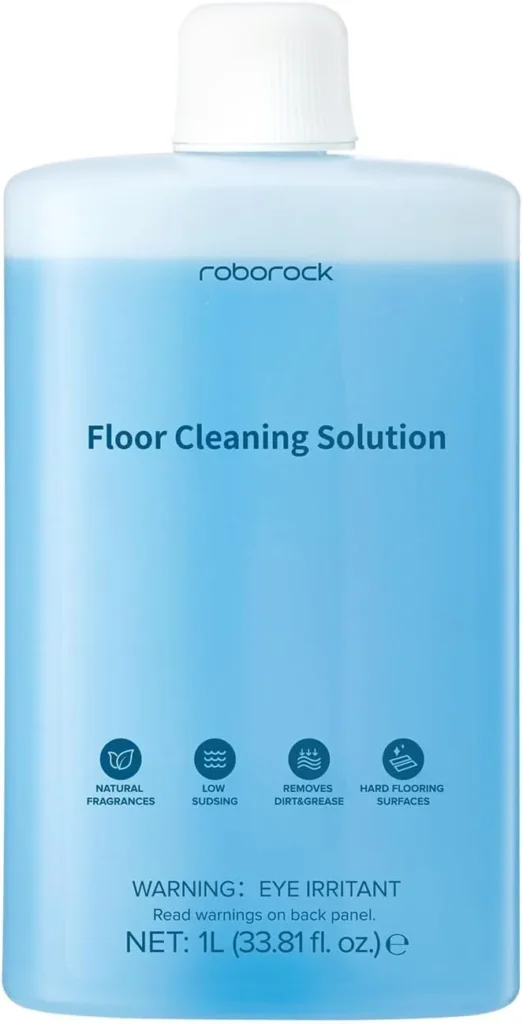
Roborock cleaning solution comes in two official bottles, and that is where most of the confusion starts. One is the 480 ml Official Floor Cleaning Solution, a concentrate. The other is the 1 L Floor Cleaning Solution, sold in the same accessory range. They are close relatives rather than the same product, and their caps measure differently.
An OMO-branded bottle also circulates, and it is not a separate product. It is the earlier, co-branded generation of the 480 ml concentrate, which gets its own section below.
This guide works through the practical questions in order. Which bottle suits your machine, and what 1:200 and 1:300 mean once you are holding the cap. Whether the liquid belongs in a tank or straight in the dock's cartridge. And what Roborock actually says about putting anything else in there.
Where Roborock publishes a figure, that figure is used here. Where it publishes nothing, this guide says so rather than guessing.
Key Takeaways
- Roborock sells two official bottles: a 480 ml concentrate and a 1 L solution.
- A tank takes a 1:200 mix, while a dock's solution cartridge takes the liquid neat.
- Caps differ between bottles, so measure by the example printed on yours.
- The OMO-branded 480 ml bottle is the earlier generation at 1:300; the current plain bottle is 1:200.
- Roborock's published position is short: its machines take Roborock cleaning solution only.
Roborock cleaning solution: the short answer
Both official bottles cover the mopping line, so the choice is mostly about how often you mop. Roborock lists each one as compatible with all its robot vacuums that mop, plus the Dyad and Flexi wet-dry vacuums. The 1 L listing goes further and names the Saros 10R, Saros 10, Saros 20 and Saros Z70, the Qrevo range, the Q and S series, and the F25 wet-dry vacuums.
Then comes the rule that decides everything else, and Roborock prints it in two lines on the same page. For the tank, dilute at 1:200. For the solution cartridge, no dilution is needed at all, and the liquid goes in neat.
Reverse those two and the machine cannot rescue you. Neat concentrate in a mixing tank is two hundred times the intended strength. A cartridge topped up with pre-diluted liquid doses at a fraction of it. So check which route your dock uses before you open the bottle.
The official bottles, told apart
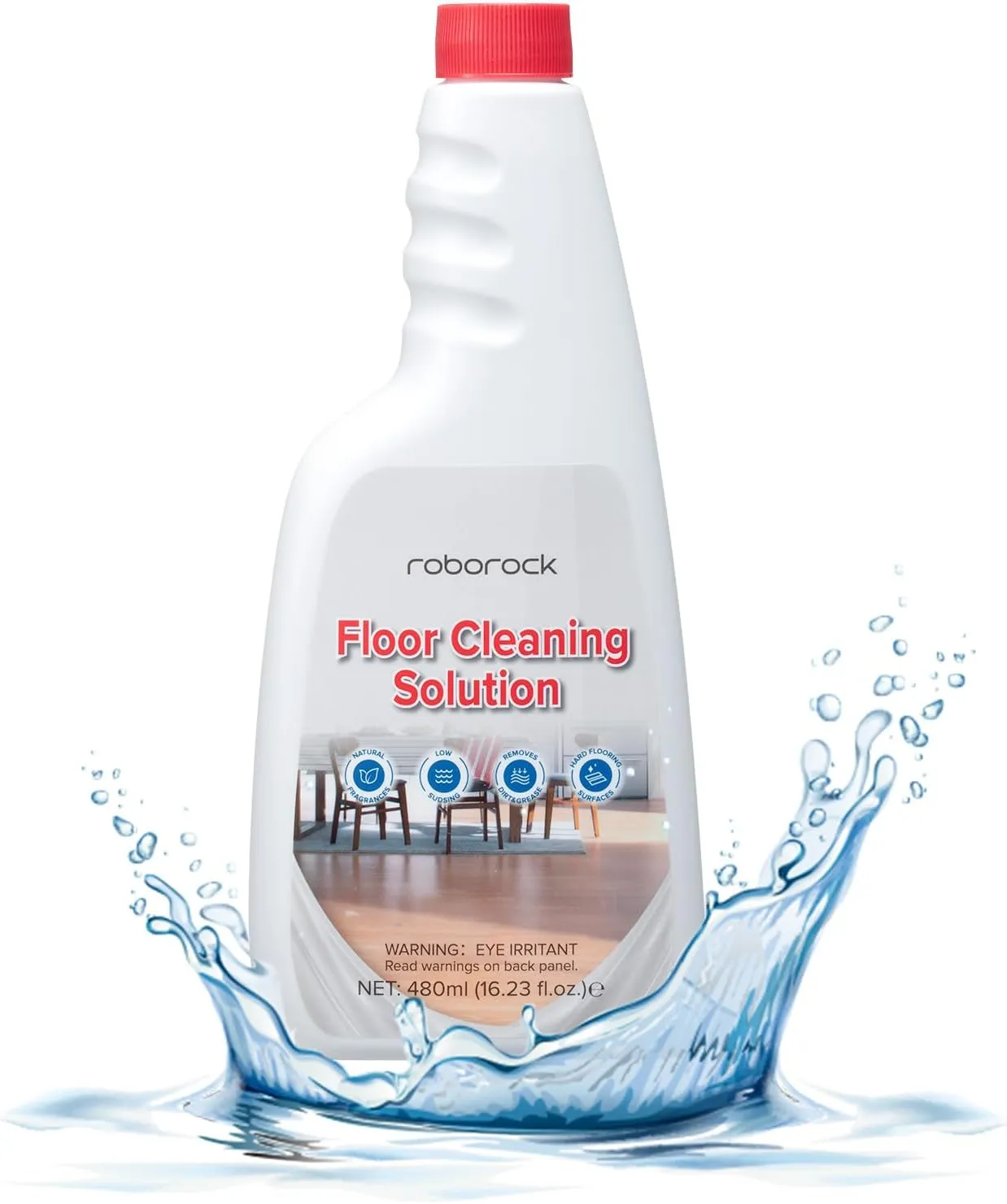
The smaller bottle is the Roborock Official 480 ml Floor Cleaning Solution for Robot Vacuums. Roborock's own page gives it two instructions: 1:200 for the tank, and neat for the solution cartridge. Its current Amazon listing prints the same 1:200, with a dosing card of two-thirds of a cap, about 5 ml, to a litre of water. The earlier generation of this bottle was sold as the Multi-Surface Floor Cleaning Solution at 1:300, so the ratio you follow is the one printed on the bottle in your hand.
Those two instructions sit on Roborock's own product page for the bottle, which is also where the cap example in the dilution section comes from.
The 1 L bottle is the plain Roborock Floor Cleaning Solution. It states 1:200, with one 20 ml cap to four litres of water. The same listing names hardwood, vinyl, ceramic tile and laminate. The label adds what the listings leave out: natural fragrances, low sudsing, and a warning that the liquid is an eye irritant. On Amazon the two sizes share one listing family, with a two-pack of the litre alongside.
Roborock also lists a 200 ml bottle among its accessories, so a third size exists.
What every Roborock cleaning solution bottle shares is a single line: compatible with Roborock products only.
The OMO bottle, explained
The OMO-branded bottle is the earlier generation of the 480 ml concentrate. It was sold co-branded with the OMO detergent brand, printed "OMO roborock Floor Cleaner Professional", with a 1:300 dilution on its own dosing card: a third of a cap, about 3 ml, to a litre of water. That listing has since gone unavailable and the plain Roborock bottle at 1:200 has replaced it, so an OMO bottle in the cupboard is genuine Roborock stock and takes the weaker mix.
Anyone still looking for the OMO version should buy the current 480 ml bottle, which is its direct replacement. The formula line and the compatibility line are the same; only the printed ratio and the cap example changed.
Bottles sold under other brand names as "compatible with Roborock" or "for OMO" are a different matter. They are third-party products, and Roborock's compatibility line does not cover them.
Dilution done right: what the ratios mean
A 1:200 ratio means one part solution to two hundred parts water. Roborock turns that into a kitchen measure on both bottles: 20 ml of solution into four litres of water. Hold on to that figure, because the caps are not interchangeable.
On the 480 ml bottle, Roborock puts the cap at about 8 ml, so its example reads 2.5 caps to make up the 20 ml, and its dosing card scales that down to two-thirds of a cap per litre. On the 1 L bottle, one cap is the full 20 ml. Same ratio, different cap, so counting capfuls from memory gets you there only by luck. Read the example printed on the bottle you own.
The 1:300 on the OMO-branded bottle is simply a weaker mix, one part to three hundred: its dosing card shows a third of a cap, about 3 ml, per litre. Neither figure is a target to beat.
Overdosing does not clean harder. Surfactant that never gets rinsed away stays behind as a thin film. That film is what you later notice as streaks, or as a tacky floor.
For the cartridge there is no measuring at all. On water itself the company publishes nothing, so there is no official line on hardness or temperature to follow.
Tank or cartridge: how your dock takes it
Where the Roborock cleaning solution goes depends on the hardware, not the model name. Either you mix it into water yourself, or the dock holds it separately and meters it in.
The tank route is the familiar one. You fill a clean-water tank, whether it sits on the robot, in the dock, or on a Dyad, Flexi or F25 wet-dry vacuum. The solution goes in with the water at 1:200, so everything leaving the machine is already mixed.
The cartridge route moves that job into the dock. A separate compartment takes the concentrate neat, and the dock doses it as it washes. The water tank then gets plain water and nothing else. Roborock's own Saros 10R page, for instance, lists an auto detergent dispenser with a 590 ml reservoir, which puts that machine on the cartridge route.
Telling them apart takes one look. If the only thing you ever fill is water, you are on the tank route. If there is a second bay that takes a bottle or cartridge of its own, that is where the concentrate belongs.
Roborock does not publish a model-by-model list of which docks dispense automatically, nor what the app exposes for dosing. That makes the manual for your machine the authority here, rather than any general rule.
Capfuls per fill, model by model
Roborock's dosing table on the 480 ml listing turns the tank route into capfuls per fill, at about 8 ml per cap.
For instance, robots that mix in a small tank on the body, such as the Q5 Pro, Q7, S7 and S8, hold between 0.14 and 0.35 litres. They take a tenth to a fifth of a cap, 1 to 2 ml.
By contrast, docks that mix for the robot, such as the S7 MaxV Ultra, S8 Pro Ultra, S8 MaxV Ultra and the Qrevo range, hold 3 to 4.2 litres. They take 2 to 2.5 caps, 16 to 20 ml.
Meanwhile, the Dyad and Flexi wet-dry vacuums sit in between, at 0.62 to 0.9 litres. They take a third to half a cap, 3 to 4 ml.
The table covers the tank route only. So a machine absent from it, such as the Saros 10R, is a hint to look for a cartridge instead.
What else can go in the tank
Roborock's published position is one sentence, repeated on every bottle: this product is compatible with Roborock products only. It names no approved third-party cleaner, and does not say what happens if you ignore the line. That sentence is the whole of the official guidance. It also covers the third-party bottles marketed as compatible with Roborock: the label there is the seller's claim, not Roborock's.
The ingredients hint at the reasoning. Roborock lists less than 5% nonionic surfactants, a detergent builder, fragrance, colorant and benzisothiazolinone. The 1 L label calls the result low sudsing. No bleach, no oil and no wax appears in that list.
How the hardware works explains the rest. A dock pumps liquid through narrow lines and washes pads in a sealed tray, and foam does not pump like liquid. Ordinary floor cleaners and dish detergents are built to suds in a bucket, the opposite requirement. Products carrying wax or oil leave a film, and a damp pad spreads it rather than lifting it.
The warranty question deserves care. Roborock's product pages carry no detergent clause, so the compatibility line reads as an instruction rather than a threat. If the terms matter, check the document that came with your machine.
How far a bottle actually goes
The arithmetic is easy once the dose is fixed. At 1:200, every 20 ml of solution treats four litres of water.
A 1 L bottle holds fifty of those doses, which works out to roughly 200 litres of finished mopping solution. The 480 ml bottle holds twenty-four, so about 96 litres at the same ratio. Follow the 1:300 printed on the OMO-branded generation instead and it stretches to around 144 litres, because a weaker mix goes further by definition.
Turning litres into refills depends on the tank, and Roborock's dosing table on the 480 ml listing supplies the sizes. A 4-litre dock takes 20 ml a fill, so the 480 ml bottle covers about 24 dock fills and the litre about 50. A robot that mixes in a 0.3-litre tank on its body takes 2 ml, which stretches the same 480 ml bottle to roughly 240 fills. A wet-dry vacuum with a 0.9-litre tank takes 4 ml, or about 120 fills.
The cartridge route has no published figure at all. Roborock states that the cartridge takes the liquid neat, but not how much it draws per wash. Watching the level is the only honest advice.
Either way, the numbers explain why small bottles last. Almost everything that reaches your floor is water.
Streaks, smells and a dispenser that stops dosing
Work these in order, because the cheapest check usually wins.
Streaks and a tacky floor point at the dose before anything else. Rebuild the mix at the printed ratio, then run one pass with plain water to lift what is already down. If streaks survive that, check the pad next. A dusty floor smears rather than cleans.
A sour smell is rarely the bottle. Start at the dirty-water tank and the mop pad, both of which sit damp between cleans. Wash them before changing anything about the solution.
Foam where you did not expect it is the clearest signal of all. Low-sudsing solution at the right ratio does not fill a tray with suds. Foam therefore suggests far too much of it, or something that was never meant to go in. Flush the tank with plain water and start again.
A cartridge that has stopped dosing is worth checking in three places: the level inside it, whether it was filled neat, and how it seats. Beyond that, the fault belongs to the machine rather than the liquid.
Conclusion
Most of the confusion around Roborock cleaning solution comes down to two questions with short answers. Which bottle: either official one fits the same machines, so buy the size that matches how often you mop. How much water: 1:200 in a tank, and none at all in a solution cartridge.
The rest is discipline. Measure with the example printed on your own bottle, since a capful means different things on the 480 ml and the litre, and the OMO-branded generation takes 1:300. Treat the compatibility line as the instruction it is.
And where Roborock publishes nothing, read the manual for your machine rather than fill the gap with a guess. That covers the cartridge dose and which docks dose automatically.
Roborock Official Floor Cleaning Solution (480 ml)
View on Amazon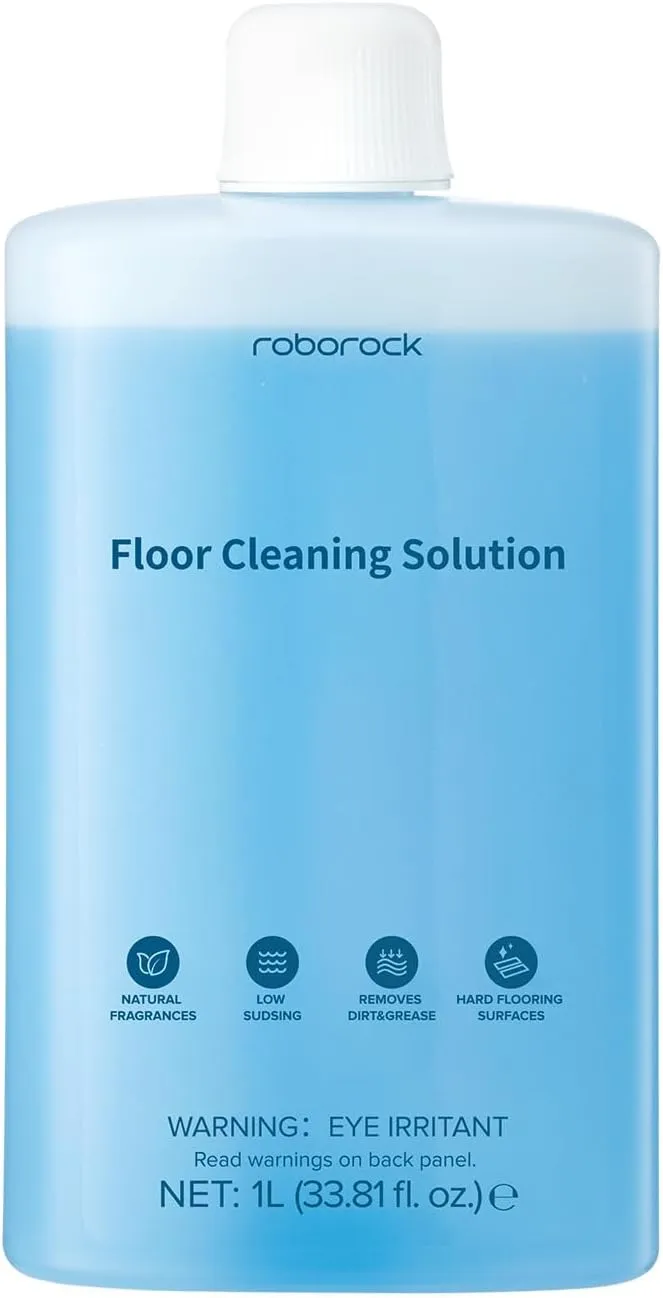
Roborock Floor Cleaning Solution (1 L)
View on AmazonFrequently Asked Questions
Is the OMO solution the same as Roborock's own?
Yes. The OMO-branded bottle is the earlier generation of Roborock's 480 ml concentrate, sold co-branded with the OMO detergent brand and dosed at 1:300, a third of a cap per litre of water. The current listing is a plain Roborock bottle at 1:200. Third-party bottles that print "for OMO" or "compatible with Roborock" are not that product and sit outside Roborock's compatibility line.
Can I use vinegar, Bona or dish soap instead?
Roborock publishes one line on the subject: its solution is compatible with Roborock products only. No substitute is named, so anything else sits outside its guidance. The practical objection is foam and film. Cleaners built to suds in a bucket, or to leave a wax layer, work against a dock that pumps liquid.
Is it safe on hardwood, vinyl and tile?
The 1 L bottle names hardwood, vinyl, ceramic tile and laminate. The 480 ml concentrate is described for sealed hard floors, and for general hard surfaces such as tiles, granite, countertops and cabinets, used as directed. Sealed is the operative word in both cases. Roborock says nothing about unsealed or waxed wood.
Does it go in the tank or in the cartridge?
Both, depending on the machine, and Roborock prints the two instructions side by side. For a tank, dilute at 1:200, which is about 20 ml of solution to four litres of water. For a solution cartridge, no dilution is needed and the liquid goes in neat. Your dock decides which applies.
How often does the solution cartridge need refilling?
Roborock publishes no refill interval and no per-wash dose for the cartridge on these product pages, so any number here would be guesswork. Check the level when you empty the dirty-water tank, a routine you are doing anyway, and top it up before it runs dry rather than on a schedule.
Is it safe around pets and children?
Roborock's own statements pull in two directions. The 1 L listing calls it safe around kids and pets when used as directed. The 480 ml bottle's page says to keep it away from children and pets, to avoid ingestion or spillage. It also names benzisothiazolinone, which may cause an allergic skin reaction. The 1 L label flags an eye irritant warning.