Sanyun SW208 Review: 60W Desktop Bookshelf Sound
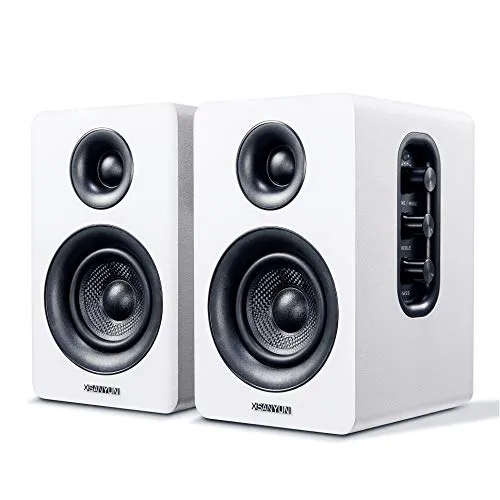
A genuinely musical little 2.0 pair with a bass tilt that wants breathing room, held back by uneven long-term reliability.
Most powered desktop speakers in the sub-$100 bracket are plastic pucks that trade bass for size. The Sanyun SW208 goes the other way. You get a real wood cabinet, a 3-inch driver per side, and 60W of built-in amplification. There is also a 24-bit DAC over USB and Bluetooth 5.0, which is unusual at this price. So the question is whether the extra cabinet volume buys real fidelity, or simply more bass than a desk can absorb.
Sound quality of the Sanyun SW208
Start with what the cabinet buys you. A 3-inch driver in a ported wood box moves considerably more air than the sealed plastic capsules that dominate this bracket. The difference is immediately audible in the lower midrange. As a result, male vocals have body. Acoustic guitar keeps a woody resonance that most desktop pairs flatten into cardboard. That is the genuine advantage here, and it is not a small one.
The frequency response is reasonably even through the mids and lower treble. That matters far more for everyday listening than any headline wattage figure. Classical and jazz, for example, come across cleanly. Podcast and dialogue reproduction is clear enough that you stop noticing the speakers, which is the correct outcome.
However, the ceiling arrives sooner than the 60W rating suggests. That number describes amplifier capability, not acoustic output. A pair of 3-inch drivers has hard physical limits. Push past roughly three-quarters volume and the low end starts to smear before the treble does. For a desk, a bedroom, or a small office this is academic, because you will rarely go there. In a workshop or a garage, though, it becomes a real constraint.
Treble is the other place opinions run hot and cold. The top end arrives bright out of the box. It is bright enough that the treble knob becomes the first stop for many buyers. Turned down, it settles into something neutral. Left alone, it can sound glassy on compressed streaming sources.
The bass tilt, and why placement decides everything
This is the single most important thing to understand before buying. It also explains most of the disagreement about these speakers.
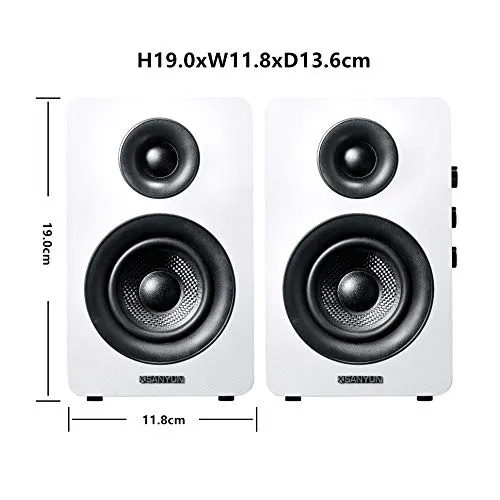
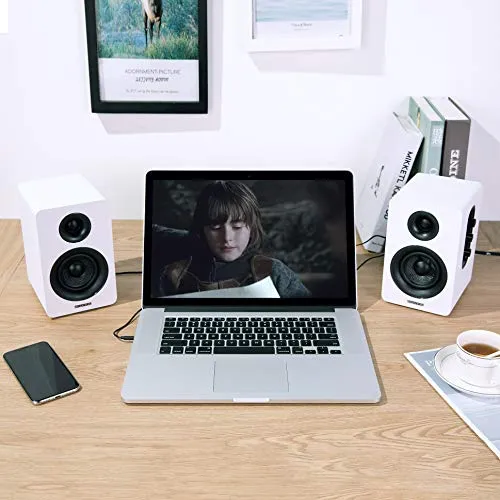
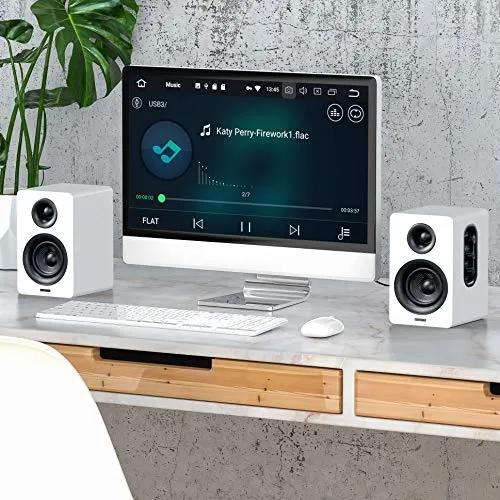
In practice, the Sanyun SW208 carries a pronounced low-end lift. Put them in a proper bookshelf position and that lift reads as warmth and scale. By that I mean set apart, a few feet from the listener, with some distance to the wall behind them. Angled inward at a wider spacing, the stereo image opens up and the bass stops dominating. Used that way, they punch well above what the price suggests.
Place the same pair eighteen inches from your face on either side of a monitor, though, and the character changes completely. At near-field distance the bass stops being warmth. Instead, it becomes pressure. Instrument separation collapses inward, and the result turns fatiguing within minutes. That is not a defect. It is the predictable consequence of a tuning meeting a listening distance it was never voiced for.
The side-mounted bass knob helps, but it does not fully solve the problem. The lift is baked into the cabinet and the port, not just the EQ stage. So if your desk is small and your head sits close, this is simply the wrong shape of speaker. No amount of knob-twisting changes that. The name is doing honest work here. These are bookshelf speakers that happen to accept a computer input, rather than desktop monitors.
Inputs, Bluetooth and the USB behaviour worth knowing
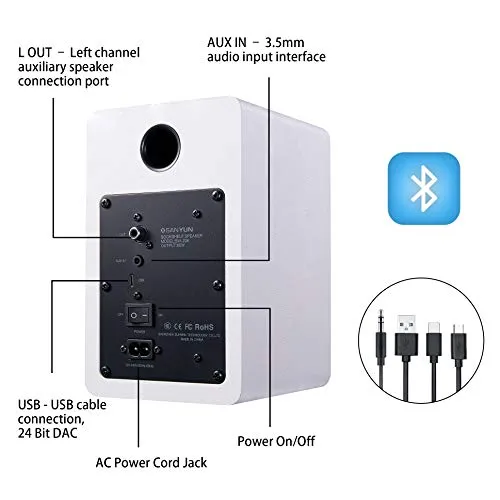
Meanwhile, connectivity is unusually generous. You get USB with the onboard 24-bit DAC, plus Bluetooth 5.0, a 3.5mm analogue input and RCA. For a 2.0 pair at this price, that covers essentially every source in a normal household.
USB is where the quirks live. On several host configurations the physical volume knob does not govern USB playback level. Instead, the knob controls the analogue stage while the USB path takes its level from the operating system. On a machine with coarse volume steps, that leaves less fine control than the hardware implies. Nothing is actually broken. Still, the manual never explains it, and the documentation is a rough translation that clarifies very little.
The second quirk is a power-cycle behaviour. Cut power to the unit and it can wake into Bluetooth mode rather than returning to USB. Therefore it needs a manual switch each time. On a desk you power down nightly, it turns into a daily irritation.
Bluetooth stability is mostly fine, though not flawless. Most setups pair quickly and hold the link. A minority hit repeated dropouts even at close range, and the pattern looks host-dependent rather than universal. If your source offers a wired option, use it. The USB and analogue paths are the more dependable connections here.
Build, controls, and what the upper element actually is
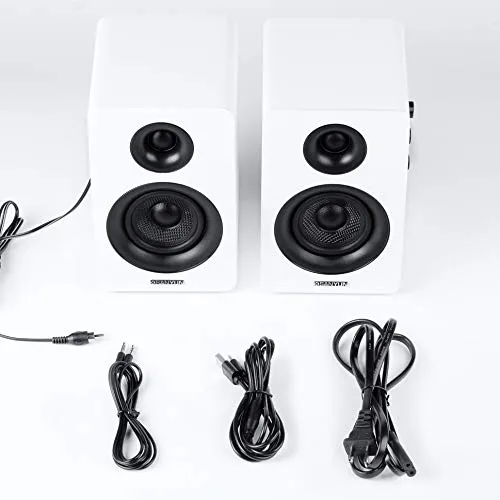
The cabinets are the reason to consider these over a plastic rival. The finish is properly applied and the corners are clean. Both cabinets carry enough mass to stay planted without pads. The left one is particularly tidy, because the drivers are mounted without exposed screws. Furthermore, the two speakers connect over a permanently attached cable terminating in RCA.
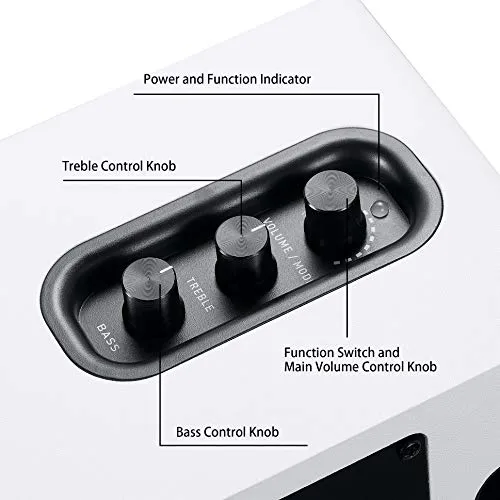
Notably, physical controls deserve credit at this price. Volume, treble and bass each get their own knob on the side of the powered cabinet. That is three real analogue controls, where most competitors give you one or none. Being able to tame the treble without opening a software equalizer is a genuine daily convenience.
One point of honesty about the driver arrangement, because the styling invites a wrong assumption. The specification describes a single carbon-fibre driver per cabinet, rated 30W a side. The smaller element visible above it is a styling feature, not a separately driven tweeter. That is a legitimate design choice at this price, and it does not make the speakers worse. But if you are buying on the assumption of a true two-way crossover, you are buying something that was never advertised.
Reliability: the real caveat
Everything above describes a strong value proposition. That said, this section is why the score is not higher.
A meaningful minority of units develop faults, and the failure pattern is consistent enough to describe precisely. It presents as crackling or buzzing that appears on low-frequency content first. Critically, it shows up at ordinary listening levels rather than after abuse. In other cases the output cuts out and returns at a different volume. Occasionally a continuous hum arrives on day one. The timeline clusters uncomfortably, with some units going inside the first month and a larger group between four and six months.
Against that, a real population of these is still running after three and four years of daily use. That tells you the design is sound. The problem is manufacturing consistency rather than a flaw every unit shares. The distinction matters for how you buy, because this is a lottery with good odds rather than a product that reliably degrades.
My read: buy from a seller with a painless return path. Then exercise the speakers hard inside the return window, at volume, on bass-heavy material, through every input you plan to use. In practice, faults in this class tend to surface early or not at all. I would not spend extra on an extended warranty. At this price the sensible hedge is a clean return policy, not an insurance product costing a meaningful fraction of a replacement.
Value, and who these actually suit
Judged on sound per dollar, this is a strong buy. Nothing else in the bracket offers a real wood cabinet, three analogue tone controls, four input types and an onboard DAC. The Creative Pebble V3 is cleaner at near-field distance. However, it sounds smaller and thinner, and it gives you far less control. The Logitech Z207 splits the difference with a flatter tuning.
The fit question is more decisive than the value question. On the other hand, the Sanyun SW208 rewards space. Put them on an actual shelf, a wide desk, or either side of a television. Given that room, they deliver a scale that genuinely surprises for the money. Conversely, compress them into a cramped monitor setup and the same qualities work against you.
There is one more group to name. If your listening runs to bass-heavy electronic material at volume, the ceiling here will frustrate you. There is also no subwoofer output to grow into. That is the point where a 2.1 system with a dedicated sub becomes the better answer, even at a higher price.
For everyone else, the Sanyun SW208 is an easy recommendation with its caveats understood. Desk music, films, games and calls all suit it well, provided the room gives it a little breathing space.
Pros: What we liked
- Pro: Real wood cabinets give lower-midrange body that plastic rivals in this bracket cannot match
- Pro: Separate volume, treble and bass knobs on the cabinet side — three analogue controls, not one
- Pro: Four input types: USB with a 24-bit DAC, Bluetooth 5.0, 3.5mm analogue and RCA
- Pro: Even response through the mids makes dialogue, podcasts and acoustic material genuinely clear
- Pro: Build quality is well above the price — clean finish, no exposed driver screws, enough mass to stay put
- Pro: Wide placement rewards you with a stereo image far bigger than the cabinet size suggests
Cons: What could be better
- Con: Bass tuning is voiced for shelf distance and turns to pressure in a close near-field desk setup
- Con: A meaningful minority develop crackle, buzz or cut-outs, clustering in the first six months
- Con: The volume knob does not govern USB playback level on many hosts, and the manual never says so
- Con: Power-cycling can wake the unit into Bluetooth instead of returning to the USB input
- Con: No subwoofer output, and the 3-inch drivers run out of headroom in loud or large rooms
Best For
- Desk setups with real width, where the speakers can sit apart rather than beside a monitor
- Listeners who want warmth and scale from a compact pair without adding a subwoofer
- Anyone who prefers physical tone controls to hunting through a software equalizer
- Buyers connecting several sources who need USB, Bluetooth and analogue on one pair
Not Ideal For
- Cramped desks where you sit within a couple of feet of both cabinets
- Bass-heavy listening at volume, or any room with significant ambient noise
- Buyers who need guaranteed multi-year reliability without a return path to fall back on
| Specification | Details |
|---|---|
| Amplification | 60W total (30W per channel) |
| Driver | 3-inch carbon-fibre full-range, one per cabinet |
| Wireless | Bluetooth 5.0 |
| Digital input | USB with built-in 24-bit DAC |
| Analogue inputs | 3.5mm and RCA |
| Controls | Volume, treble and bass knobs (side-mounted) |
| Cabinet | Ported wood, two-cabinet 2.0 configuration |
| Subwoofer output | None |
Alternatives Worth Considering
Final Verdict
The Sanyun SW208 earns its place on the strength of its cabinet. Real wood, real tone controls, and a lower midrange that plastic desktop pairs simply cannot reach at this price. Given room, it sounds considerably more expensive than it is. Two things keep the score honest, though. The bass tuning punishes close near-field placement, and the reliability record is good rather than uniform. So buy it for a shelf or a wide desk, test it hard inside the return window, and it remains one of the better value propositions in budget desktop audio.
Frequently Asked Questions
Are the Sanyun SW208 speakers too bassy for a computer desk?
They can be. The tuning is voiced for shelf distance, so sitting close to both cabinets makes the low end feel heavy and crowds the stereo image. Spacing them wider and lowering the bass knob helps, but a narrow desk is not the right home for them.
Does the volume knob work over USB?
Often not as you would expect. On many hosts the knob governs the analogue stage, while USB playback takes its level from the operating system. You control volume from the computer instead. It is a documented-nowhere quirk rather than a fault.
Is the small element above the main driver a tweeter?
No. The specification lists a single carbon-fibre full-range driver per cabinet at 30W a side. The upper element is a styling detail, not a separately driven tweeter, so treat this as a one-way design.
Can you add a subwoofer?
There is no subwoofer output, so the low end is whatever the two cabinets produce. If you want deep bass for electronic music or films, a 2.1 system with a dedicated sub is the better starting point.
How reliable are they long-term?
Mixed. Plenty of units run for three or four years without complaint. A real minority, though, develop crackling, buzzing or cut-outs, most often within the first six months. Buy where returns are easy and exercise them properly early on.
The Verdict
A genuinely musical little 2.0 pair with a bass tilt that wants breathing room, held back by uneven long-term reliability.