Klipsch ProMedia 2.1 Review: THX Certified Speaker System

Desk audio with genuine scale and horn-driven clarity, and most systems keep delivering it for years - plan around the always-on design and the minority that fails early.
Twenty years after it first appeared, the Klipsch ProMedia 2.1 still does the thing that made its name: it plays with the scale and authority of something far larger than a desk. Klipsch rates the system at 200 watts of peak power, and the 6.5-inch subwoofer underneath makes that number mean something. The horn-loaded satellites put genuine detail on top of it. Whether it sounds good is not the open question – it does, emphatically. The narrower questions are how the tuning behaves at the extremes of the volume range, how a system with no power switch fits into a room, and what the years do to it.
Output, headroom and the scale of the sound
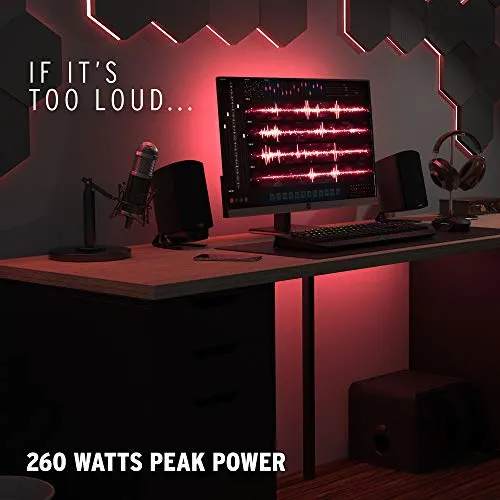
Klipsch rates this system at 200 watts of peak power and 110 dB in room. Numbers like that usually deserve a shrug. Here they hold up: the Klipsch ProMedia 2.1 plays far louder than a desk ever needs, and it fills an ordinary room while doing it. A home office, a den, a bedroom – all comfortably covered without pushing the volume far.
More useful than the ceiling is what happens on the way up to it. Bass stays defined as the level climbs, and nothing audibly strains anywhere in the range a desk lives in. That reserve is the best thing about the system: most setups run it at a fraction of its range, which is exactly where a design with this much headroom sounds relaxed. Films and games ask for sudden swings in level, and a system with this much in hand takes them without hardening up. My own read is that the headroom, more than the horn, is what makes it sound so easy at ordinary desk volumes.
There is a counterweight, and it belongs here. Pushed hard in a small room, the top end gets wearing, and it can turn tiring inside a short session. I read that as a question of tuning more than one of output.
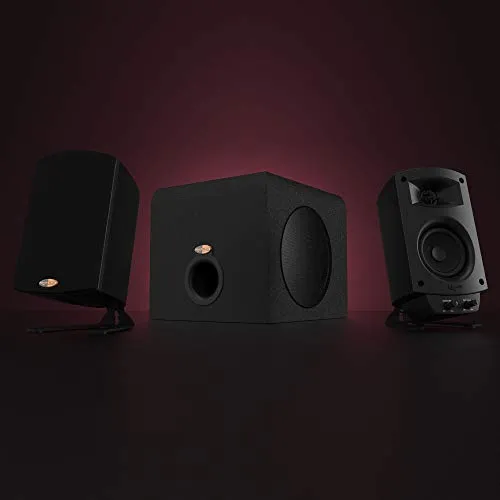
Horn treble and the character of the midrange
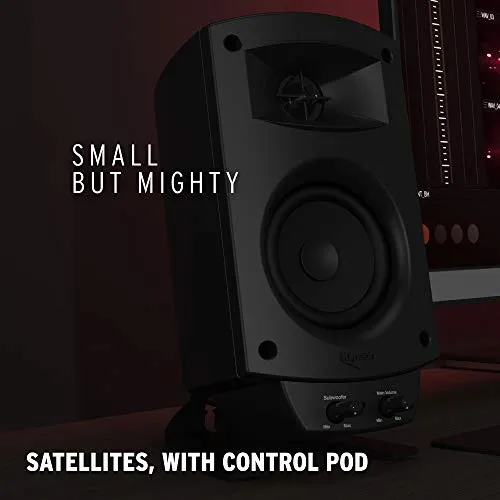
The satellites are two-way units built around a 3-inch midrange driver, and Klipsch credits its MicroTractrix horn design for the clarity it advertises. Whatever the mechanism, the Klipsch ProMedia 2.1 puts out a presentation with a great deal of energy up top. Detail is genuinely there – cymbal texture, string attack, the edges of consonants in dialogue – and for a lot of listening that is the entire appeal.
It is also the dividing line. The treble runs forward enough that on bright or heavily compressed material it tips into sizzle, reading as strident where the source is unkind. If you already know you prefer a rolled-off top end, that is a real reason to look elsewhere. The control pod carries main volume and subwoofer gain, so treble shaping has to happen upstream, in whatever equalizer your computer or player provides.
The midrange holds up better than the extremes. At working volume it is clear and well separated, and dialogue, podcasts and acoustic material all come through cleanly. Drop the level right down and something else happens: the mids and upper bass thicken and lose their edges, and the sound goes boxy in a way it does not at normal listening levels. How much that matters comes down to how low you tend to keep the volume.
The subwoofer and the gain knob that earns its keep
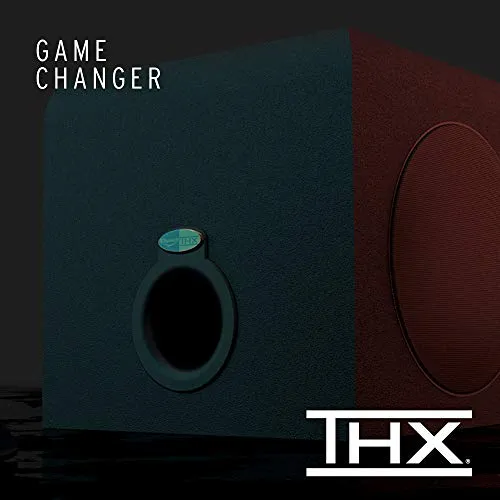
Underneath sits a 6.5-inch side-firing ported subwoofer, and it is why the Klipsch ProMedia 2.1 reads as so much bigger than its footprint. The low end has real extension and physical weight – bass you register in your chest at moderate levels and feel through the floor at high ones.
Out of the box, it is also too much for most desks. The subwoofer gain on the control pod is no decorative dial: expect to spend real time with it, and expect to settle well below the middle. Turned down sensibly, the bass locks in with the satellites and stops announcing itself. Left where it arrives, it walks over vocals and makes a small room boom. Getting there takes a couple of passes: set the gain by ear on music you know well, then check it again on speech, which is where an over-set subwoofer gives itself away first.
Placement deserves a moment. The cabinet runs a little under ten inches on each side, so it disappears under most desks, and the side-firing driver is forgiving about which way it points. One thing I would watch: the amplifier end of the subwoofer runs warm in normal use. Leave it some air – a closed cubby or a pile of soft furnishings is the wrong home for it.
Setting up the Klipsch ProMedia 2.1
Klipsch describes the setup as plug and play over a 3.5 mm input, and lists TVs, computers, music players and games consoles among the compatible sources. That is broadly how it goes. Cabling is generous enough to reach around a large desk, and nothing wants drivers or software.
Two details are worth understanding before the box is open. The first is the control pod, which carries the main volume, the subwoofer gain and a headphone output, and clips onto one of the satellites. If the speakers sit wide apart – and on a system with this much output they should – your volume control ends up at arm's length on one side of the desk. Plan the layout around where you want your hand to land.
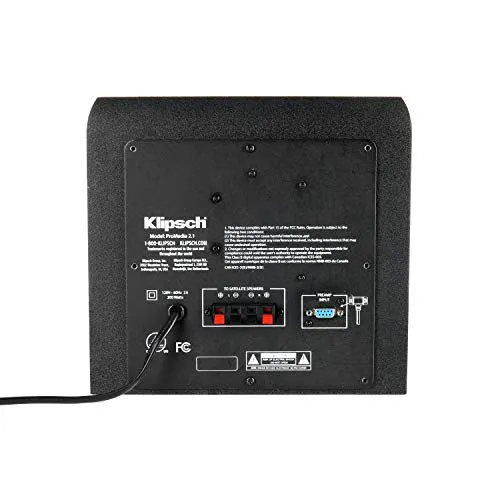
The second is the wide multi-pin connector carrying signal between the subwoofer and the rest of the system. It is a serial-style plug with retaining screws, and it does not always leave the factory firmly seated. A Klipsch ProMedia 2.1 that arrives apparently dead – no subwoofer, or one channel silent – sometimes comes back to life once that plug is pushed home and its screws tightened. Check that before you conclude the unit is faulty. Five minutes there can save a return.
Living with it: standby power, light and hiss
Two practicalities shape daily use, and neither has much to do with sound. The first: the Klipsch ProMedia 2.1 has no power switch – not on the control pod, not on the subwoofer. Once it is plugged in it is powered, and the pod's indicator light stays lit to prove it. In a bedroom or a dark office, that light is bright enough to need covering.
The second is the noise floor. Some units carry an audible hiss or hum under everything with no source playing, easy to pick out from the chair in a quiet room. Plenty of systems are silent; where it does turn up it tends to stay. Treat the first quiet evening with a new set as a check rather than an assumption.
Both have the same cheap answer: a switched power strip or a smart outlet, which handles the standby draw and the indicator together. It is a workaround and not a fix, and I would rather not need one on a system at this level. Still, it is a one-off job that settles the point for good.

A caveat on longevity, and how it shows up
Most Klipsch ProMedia 2.1 systems run for years without incident – four years, seven years, and in the oldest cases a decade or more of daily use. That is the ordinary outcome, and it is a large part of why the design has lasted as long as it has. The exception is the thing to understand, because it is specific enough to plan around.
The failures that do occur follow a recognisable pattern. Sound begins cutting in and out above low volume; the satellites go quiet while the subwoofer keeps playing; sometimes the system stops powering up at all. Traced, the fault usually sits in the subwoofer's internal amplifier or in the control pod. The timing is the uncomfortable part: when it happens, it tends to land between the first year and the second, past the return window and often past the coverage that would have paid for it. Inside that coverage window Klipsch has been responsive and replacements have gone through. Past it, the usual outcome is a discount code toward another purchase.
Arrival faults are a separate strand – a silent satellite, a dead channel, a subwoofer that never plays. Some of those trace back to the multi-pin connector and cost a screwdriver to put right. One habit covers both cases: order where a return is painless, and put a new set through a hard week while that option is still open.
Where the value lands
So what does the money buy? Scale, clarity and headroom in a package sized for a desk. On sound alone the Klipsch ProMedia 2.1 is hard to argue with, and it stretches past its category name: it works perfectly well as the main sound in a small room – a bedroom television, a den, a home office doing double duty as a listening space. That second life deserves to be taken seriously. Some of these end up under a television or in a spare room carrying the main sound, and the output reserve is what makes that work.
This is not budget money, and at that level the fair question is what the system gives back. Output and extension are the answer, with a control pod that puts the bass balance in your hands and a headphone output for the hours when the subwoofer would be antisocial. The design has earned its two decades on that.
The conditions attached are small and cheap: a switched outlet for the standby light, the subwoofer gain turned well down, and a hard first week while the return option is open. Do those three things and what you have is a desk that plays properly loud, with weight underneath and detail on top.
Pros: What we liked
- Pro: A 6.5-inch side-firing ported subwoofer with real extension and physical weight underneath the music
- Pro: Two-way horn-loaded satellites with a forward, detailed top end that holds up on dialogue and acoustic material
- Pro: Rated at 200 watts peak and 110 dB in room, with enough headroom that nothing strains at desk volumes
- Pro: Fills an ordinary room comfortably – it works as the main sound for a den, a bedroom television or a home office
- Pro: A separate subwoofer gain on the control pod makes the bass genuinely adjustable
- Pro: Long service lives are the norm – most run for years, and the oldest sets have passed two decades
Cons: What could be better
- Con: A minority of units fail early, usually in the subwoofer amplifier or the control pod, and past the coverage window support tends to end in a discount code
- Con: No power switch on the control pod or the subwoofer, and a bright indicator light that stays lit until you pull the plug
- Con: Some units carry an audible idle hiss or hum with nothing playing, and where it appears it tends to stay
- Con: The top end runs forward enough to turn tiring on bright or heavily compressed material at volume
Best For
- Anyone whose priority is scale and volume from a desk, with a footprint to match
- Listeners who want physical bass without building a separate subwoofer and amplifier into the setup
- People running a small room's main sound from a desk or a television
- Buyers who can order where returns are painless and will exercise the system hard in the first week
Not Ideal For
- Listeners sensitive to a forward, energetic treble, or who mostly listen at very low volume
- Quiet rooms where a permanently lit indicator light would grate every evening
- Anyone who needs a system that powers down at the speakers, not at the wall socket
| Specification | Details |
|---|---|
| Configuration | 2.1, three-piece – two satellites and a subwoofer |
| Certification | THX Certified |
| Maximum output | 200 watts peak power, 110 dB (in room) |
| Satellites | Two-way, with 3-inch midrange drivers |
| Subwoofer | 6.5-inch side-firing, ported |
| Input | 3.5 mm, plug and play |
| Controls | Control pod with main volume and subwoofer gain |
| Satellite dimensions | 8.5 x 4.2 x 5.67 in |
| Subwoofer dimensions | 9.5 x 9.8 x 10.2 in |
| Finish | Black |
Alternatives Worth Considering
Final Verdict
Two decades on, the thing this system does best is still the thing it was built to do: put genuine scale and genuine clarity on a desk, at volumes a desk has no business reaching. Set the subwoofer gain where it belongs, give the always-on design a switched outlet, and what is left is a system that gets out of its own way. The Klipsch ProMedia 2.1 is a sound-first purchase, and judged on sound it is still an easy recommendation.
Frequently Asked Questions
Is there a power switch?
No – not on the control pod and not on the subwoofer. Once it is plugged in the system is powered, and the indicator light stays lit. A switched power strip or a smart outlet is the usual answer.
Why is there a hiss or hum when nothing is playing?
Some units carry an audible idle noise floor, easy to hear from the chair in a quiet room. Plenty of systems are silent. Where it does appear it tends to persist, so treat the first quiet evening as a check.
The subwoofer is not playing – is the unit dead?
Not necessarily. Check the wide multi-pin connector between the subwoofer and the rest of the system: it does not always leave the factory firmly seated, and pushing it home and tightening its screws revives some apparently dead units.
How long does it last?
Most run for years – four and seven are ordinary, and the oldest sets have passed two decades. A minority fail earlier, usually between the first year and the second, in the subwoofer amplifier or the control pod.
Is the bass too much for a desk?
Out of the box, usually. The subwoofer gain on the control pod is a real control, and most setups end up well below its midpoint. Turned down, the low end locks in with the satellites and stops walking over vocals.
Will Klipsch repair it if it fails?
Inside the coverage window replacements have gone through and the service has been responsive. Past it, the common outcome is a discount code toward another Klipsch purchase.
The Verdict
Desk audio with genuine scale and horn-driven clarity, and most systems keep delivering it for years - plan around the always-on design and the minority that fails early.