JBL PartyBox 310 Review: Loud, Clean Sound You Can Shape
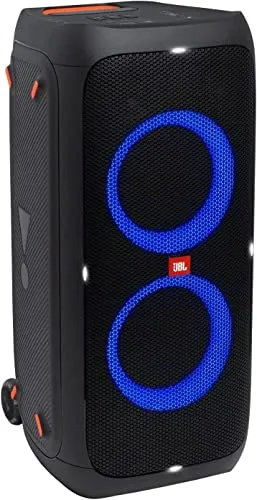
Plugged in or on battery, alone or paired, it plays loud and clean with deep bass, though it hits hardest on the cord and its heavy cabinet rocks on narrow wheels over rough ground.
The JBL PartyBox 310 plays very loud and stays clean at full volume, with deep, hard-hitting bass. Everything else it offers comes second to that sound. It can play from its battery or its power cord, though the cord gives it more punch. Its lights pulse and strobe to the music, or they can stay dark. A microphone, a guitar or a second 310 can join it.
The costs sit elsewhere, and no setting removes them. The cabinet is heavy and tall. Its narrow wheels wobble on uneven ground, and its price is high.
Loud without breaking up
JBL rates it at 240 watts and calls the result pro sound. At its loudest, the JBL PartyBox 310 stays clean, with no distortion creeping in. The bass stays clean too, without popping even when pushed. It sounds good across most genres. Its bass goes deep and hits hard, while the treble comes through crisp. Still, the low end stays in proportion with the rest.
Its ceiling is high, though a big dance floor can still want more. For a crowd that size, a second cabinet is the surer answer. Most gatherings never get that big, however.
Outdoors, one JBL PartyBox 310 covers a ballfield or a big backyard. Ballgames suit it especially well, since the music carries to the far side of the field. Even at that distance, it still sounds clear. It holds that level through a whole event, so community events are within its reach. Played loud, it carries well past the fence and the property line. Decks and patios suit it as well. Birthdays and holiday get-togethers are home ground for it.
Indoors, it shakes a house long before the dial runs out. Turned up, it's loud enough to bother the neighbors. For a shared wall or a late hour, the app's EQ can take the bass down. Daytime gatherings outdoors can take everything it has, while evenings in a shared building suit half volume and a lighter low end.
A charge for the day, the cord for the night
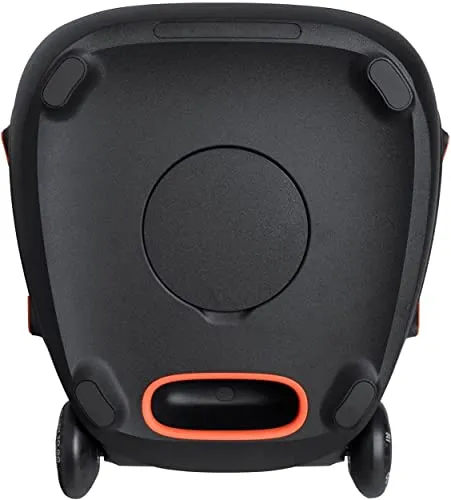
JBL quotes 18 hours of music-blasting battery life. A charge can come close to that figure. Driven hard, though, it usually lasts an evening, roughly five to ten hours. That gap matters most at a party away from the house, where a dead battery cuts the music short.
For a party that runs past midnight, the power cord takes over. It plays while plugged in and charges from the same cord, so a long night simply needs a socket nearby.
The cord also changes the sound. On battery, the JBL PartyBox 310 holds back some of its output. Plugged into a wall, it plays a little louder and hits harder in the bass. Even on battery, it still has plenty of volume for a backyard or a ballgame.
Away from a socket, any night that matters calls for planning around the lower battery figure. That planning is simple, because a full charge before leaving and the cord in the car cover most nights.
It doesn't have to wait for a party. In a garage or a home gym, it can stay plugged in and play every day. At work, it covers a machine shop or a warehouse aisle through a long shift. At home, it keeps pace with workouts and weekend chores. Half volume is already plenty for a living room or a garage.
Size is the main thing to plan around indoors, because the cabinet stands 27 inches tall and takes up a real corner. Once it has a spot near a socket, however, it can stay put between outings. It also looks good enough to leave out in a living room. For a speaker bought for parties, that everyday role is a large part of its value.
Smooth ground for the wheels
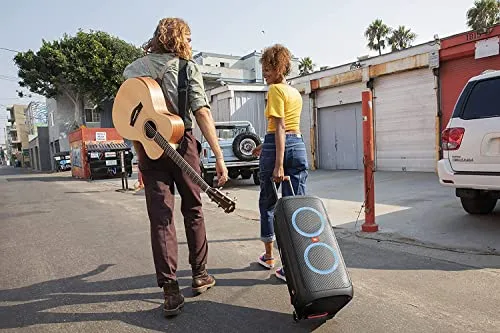
A telescoping handle does most of the moving. It pulls the solidly built cabinet along like a suitcase, and on smooth floors and pavement that works well. The handle slides back down when the speaker stands still. Built-in grips on the body make short carries manageable, though lifting 38.4 pounds into a car still takes real effort.
Rough ground is another matter. The wheels are narrow and skate-like, and the cabinet rocks on them over grass, gravel, sand or broken pavement. Left unchecked, that rocking can tip it over. Speed makes the rocking worse, so a slow, steady pull works best. Door thresholds and sidewalk bumps can set it rocking too.
Larger, wider wheels would have steadied the JBL PartyBox 310. For a speaker JBL calls portable, the wheels are the part of the design that most needs work. They're an odd weak spot on a cabinet otherwise built so solidly. On a beach or a long lawn, I'd bring a cart.
Outdoor use also scuffs and scratches the finish over time. JBL rates the cabinet IPX4 splashproof and says it keeps playing rain or shine.

The app is for fine-tuning
Getting music into it takes seconds. Phones pair over Bluetooth quickly, iPhones included. After pairing, the connection holds steady. A tablet works as a source as well, which puts karaoke lyrics on a bigger screen. Once the JBL PartyBox 310 is connected, the buttons on top handle most settings without the app. Those buttons are also well placed and simple to learn. For plain playback, the app can stay closed.
Two controls shift the balance between the bass and the rest. A bass-boost setting adds more low end on demand. The PartyBox app adds an EQ that makes an audible difference, crisper at one setting and lighter in the bass at another. The app is straightforward to use, and it also runs the light show and switches tracks. Because the EQ is simple, changing it takes only a moment. My advice is to set it early and then keep the boost for outdoor nights.
Strobes are optional
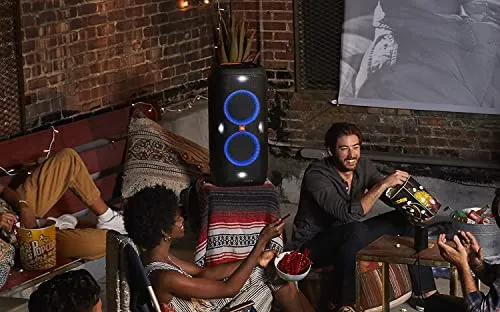
JBL bills the lights as a show. Its listing promises subtle pulsing and powerful strobing that dance to the beat, and the effects do follow the music. Rings of light circle the drivers on the front, with strobes alongside them. They look good on the front of the black cabinet, too. The PartyBox app picks among light patterns. The lights add a lot to a party's atmosphere.
Not every room wants a strobe, though. At a quiet gathering the show adds little, and the strobes can feel like too much. The lights also switch off completely. Run dark, the JBL PartyBox 310 loses only the glow. Treat the show as a bonus rather than a reason to buy.
Room for a singer and a guitarist
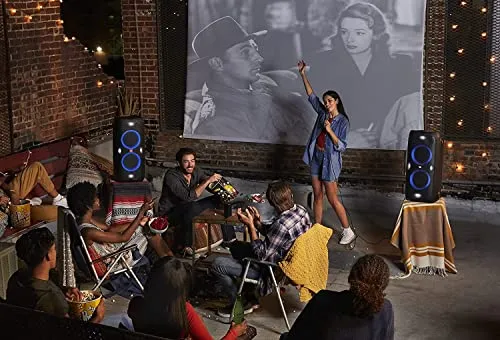
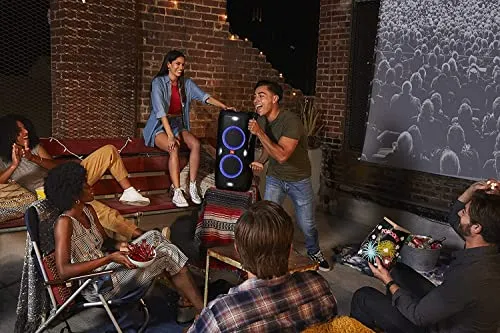
The inputs suit karaoke nights and small live sets. There are sockets for microphones and for a guitar. On the JBL PartyBox 310, the inputs have their own volume, bass and treble controls, apart from the music. A guitar and a microphone can run at the same time. JBL also lists karaoke controls in the PartyBox app, alongside the music and the lights.
It doubles as a small sound system for a choir or a community event, with a microphone in use. For karaoke, those separate controls matter more than any light effect.
Microphones are an extra purchase. The box holds only the speaker, a power cord, a quick-start guide and the warranty and safety sheets. For a karaoke plan, they belong in the budget from the start.
Sales soften the premium
It's a premium-priced speaker. A stereo pair doubles that outlay. Holiday deals and flash sales cut the price noticeably, so a sale is the sensible time to buy. The premium buys the sound first, then the inputs, the pairing and the lights. The weight and the wheels, however, come with it at any price.

A second JBL PartyBox 310 for stereo
Two cabinets can play as a stereo pair. The link is wireless, with the left and right channels split between them. A second JBL PartyBox 310 adds width as well as volume. Paired, two cabinets can carry a whole event on their own.
The pairing starts from a button on the cabinet or from the app. The two cabinets can then stand on opposite sides of a yard or a living room. JBL PartyBoost, however, isn't among the features JBL lists for the 310. A plan to mix the 310 into a group of different JBL speakers therefore needs checking before ordering.
One cabinet is enough for most backyards. The second one doesn't have to arrive with the first, so it can wait for a later sale. In my view, the second earns its place only once the space, or the crowd, clearly outgrows the first.
Pros: What we liked
- Pro: Very loud, and clean at full volume, with deep, hard-hitting bass
- Pro: Mic and guitar inputs with their own volume, bass and treble controls
- Pro: Runs on its battery or the included power cord, and keeps playing while plugged in
- Pro: Two cabinets link wirelessly as a stereo pair
- Pro: App EQ and a bass boost reshape the sound, and the light show switches fully off
Cons: What could be better
- Con: At 38.4 pounds on narrow wheels, it rocks and can tip over on grass, gravel or broken pavement
- Con: Played loud, a charge lasts an evening, well short of JBL's 18-hour figure
- Con: Holds back some output on battery, so full power needs the cord
Best For
- Hosts of backyard parties and ballgames who need volume that carries
- Karaoke hosts and solo guitarists who need mic and guitar inputs
- Garages and workplaces where the speaker can stay plugged in
- Anyone planning a stereo pair of the same model for a large space
Not Ideal For
- Anyone who must carry it alone over sand, grass or long distances
- All-night events far from an outlet with the volume turned up
| Specification | Details |
|---|---|
| Output | 240 W (JBL's figure) |
| Battery | Up to 18 hours (JBL's figure) |
| Power | Battery-powered; power cord included |
| Water resistance | IPX4 splashproof, per JBL |
| Light show | Music-synced, with pulsing and strobing effects |
| App | JBL PartyBox app: tracks, light show and karaoke controls |
| Dimensions | 27 x 14.5 x 12.8 in (height x length x width) |
| Weight | 38.4 lb |
| In the box | Speaker, power cord, quick-start guide, warranty and safety sheets |
| Color | Black |
Alternatives Worth Considering
Final Verdict
Its sound is the constant here. Loud, clean and deep in the bass, it keeps that character on battery or on the cord, alone or in a pair. Besides the sound, the inputs and the stereo link widen what one purchase covers. What it asks for in return is planning, such as a socket for a long night and smooth ground or a cart for the trip.
No setting lightens the haul, though. On sale, the sound outweighs both the haul and the bill. For frequent hosting, this one box handles the music side of a party on its own. Sound this loud and this clean makes the JBL PartyBox 310 a strong recommendation despite its weight.
Frequently Asked Questions
Is the JBL PartyBox 310 loud enough for an outdoor party?
Yes. On its own, it fills a backyard or a deck, and at full volume it covers a ballfield. Its very loudest setting needs the power cord, because it holds some output back on battery.
How long does the JBL PartyBox 310 battery last?
JBL's figure is 18 hours, and a charge can come close to it. Played loud, it gets roughly five to ten hours. For most day outings, the party ends before the charge does.
Does the JBL PartyBox 310 come with microphones?
No, they are a separate purchase. JBL's own wireless mics pair with it cleanly, and wired mics plug into the sockets on the cabinet.
Can it go on a speaker stand?
Yes. It goes up on a speaker pole or a tripod.
The Verdict
Plugged in or on battery, alone or paired, it plays loud and clean with deep bass, though it hits hardest on the cord and its heavy cabinet rocks on narrow wheels over rough ground.