JBL Boombox 3 Review: Big Sound, Real Trade-offs
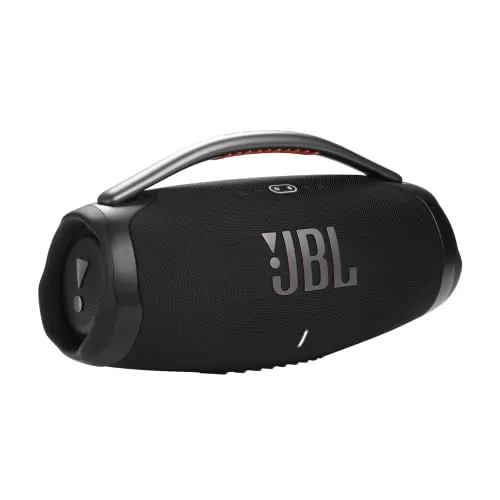
A tank of a party speaker with huge bass and a rugged IP67 build - just don't count on the 24-hour battery claim or flawless Bluetooth.
If you want the biggest, bassiest portable speaker JBL makes, the JBL Boombox 3 is it. That single fact drives almost everything about whether it's right for you. This is a 15-pound slab built to flood a backyard, a workshop, or a warehouse with sound. The low-end is the kind you feel in your chest. It is not a grab-and-go speaker for the kitchen counter. Next to the Boombox 2 it replaces, the 3 plays louder and hits harder. The trade-off is shorter battery life when you push the volume.
The sound and the build are genuinely excellent. Where the JBL Boombox 3 gets complicated is the gap between the spec sheet and daily use. The headline 24-hour battery only holds at low volume. The Bluetooth is rock-solid on most units, yet flaky on others. None of that makes it a bad speaker. It just means the marketing oversells a couple of things that matter day to day. At this price, those quirks count for more than they would on a cheap speaker.
Sound quality of the JBL Boombox 3
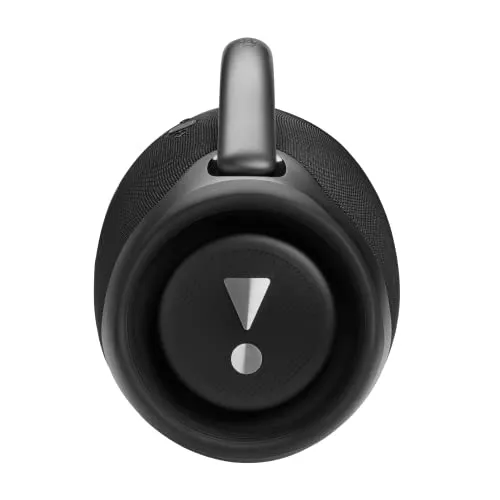
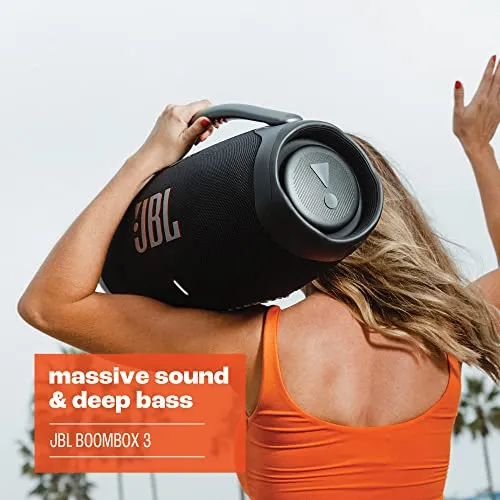
Sound is the reason most people buy the JBL Boombox 3. It delivers output that embarrasses far smaller speakers. Dual woofers, separate tweeters, and side-firing passive radiators move serious air. As a result, the bass lands with real physical weight, not a polite thump. Crank it in an open backyard, and it carries across the whole space. Indoors, it will rattle windows at a third of its volume.
Clarity holds up well through most of the range. Vocals stay present. The highs stay crisp without turning brittle. It handles bass-heavy genres best, though acoustic and vocal tracks come through cleanly too. Push past three-quarters volume with heavy tracks, however, and the low-end starts to swamp the mids. Some units even show audible distortion near the top of the dial. Most listening happens well below that point, so it rarely becomes a problem.
Two quirks shape how it sounds in a room. First, the drivers are side-firing and fairly directional. The fullest bass arrives when the speaker faces you. Stand directly behind it, and the low-end thins out. Second, set up the three-band EQ in the JBL Portable app. The stock tuning leans warm and bass-forward, so a quick adjustment helps. Against a dedicated party speaker like JBL's PartyBox line, the Boombox 3 is loud, but not that loud.
Design and build quality
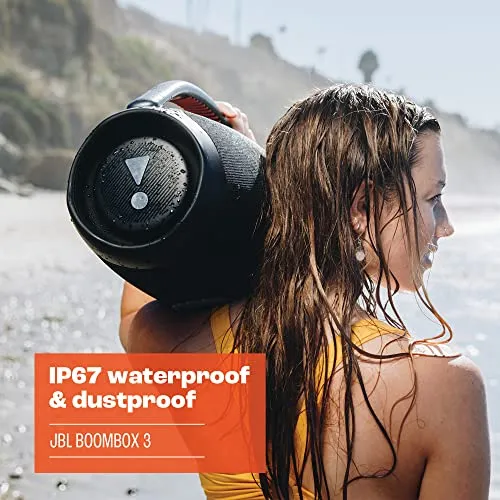
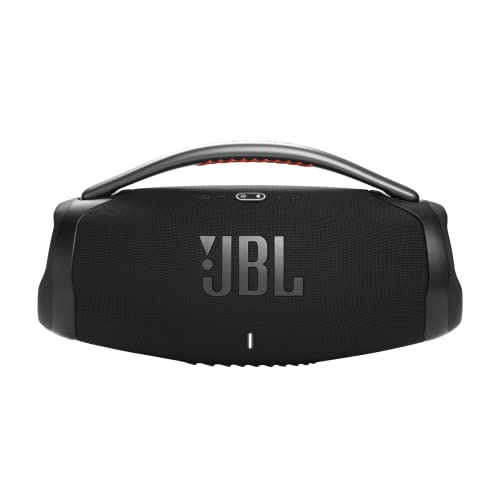
Build quality is where this speaker justifies its heft. The chassis feels genuinely rugged. Tough rubberized fabric wraps the body, and a structural metal handle anchors the top. Nothing flexes or creaks. It shrugs off treatment that kills lesser speakers. Drops onto concrete, snow, rain, and dusty job sites all leave it playing. The payoff is a speaker built to last for years of outdoor use.
The Boombox 3 carries an IP67 rating under IEC 60529. That means it is both dust-tight and waterproof to a meter, not merely splash-resistant. In practice, it holds up. It survives poolside spills and brief dunks, and it even floats. One real-world note is worth flagging. After a full submersion, it keeps draining water for a while. Let it dry before you set it on anything you would rather not soak.
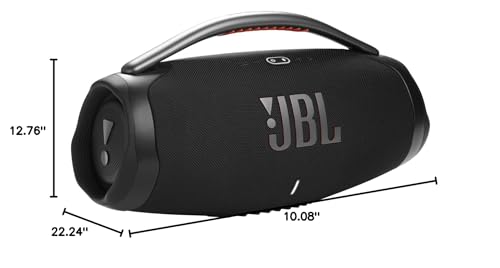
The downside of all that ruggedness is weight. At around 15 pounds, this is a speaker you carry deliberately. Most people use two hands. The metal handle helps, yet this is no casual travel speaker. The base is also fairly narrow for the body. On an uneven surface it can tip. So mind it near a pool edge or a tailgate, where a bump could send it rolling.
Battery life and charging
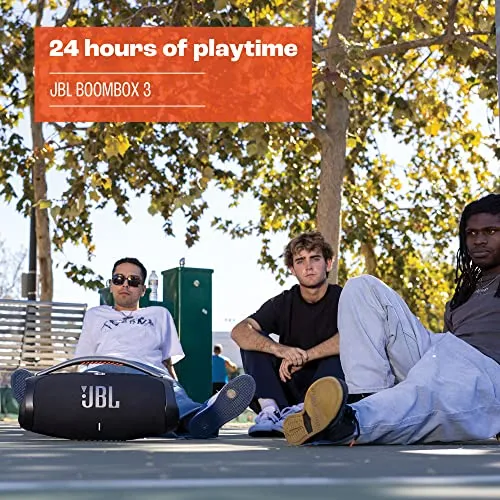
Battery life is this speaker's most divisive spec. JBL rates the JBL Boombox 3 at up to 24 hours. At low, background-music volume, it can genuinely run most of a day. The catch is that the rating assumes gentle use. Drive it hard outdoors, and real playtime drops sharply. High-volume sessions land closer to three to six hours before a recharge.
That split is worth understanding before you buy. Listen at moderate levels, and the endurance feels generous. Crank it at a party or a job site, and you should plan on bringing power. The bass also tightens noticeably on wall power. For an all-night event, running it plugged in gives you the fullest low-end and unlimited runtime. If you host often, a spare cable near the outlet saves the night.
On the practical side, it doubles as a powerbank. It can charge a phone or two over USB, which helps on long outdoor days. Charging over USB-C is convenient, even if the fill time tests your patience. Two things are worth watching. A full charge takes a while. Some boxes have also shipped without the AC adapter. Confirm what's included, and budget for a cord if yours arrives bare.
Connectivity, Bluetooth, and PartyBoost
Connectivity is the weakest area. It is also the one place the experience varies wildly from unit to unit. On most speakers, the Bluetooth simply works. Pairing is quick, and the connection stays stable at normal distances. On a meaningful minority of units, though, it misbehaves. It drops out within a few feet. It refuses to auto-reconnect at power-on. It cuts audio briefly every several seconds. Updating firmware through the app resolves some cases, but not all of them. When it works, the wireless experience is seamless; when it doesn't, it's the most frustrating trait here.
PartyBoost, JBL's multi-speaker linking feature, is similarly hit-or-miss. Linking two Boombox 3 units for stereo can sound fantastic. Even so, the connection has a short range. Walk between the speakers, and it may drop or emit loud pops. There's also a frustrating wrinkle. Once two units are paired, the app disables the EQ. That flattens the rich stock tuning into something noticeably tamer.
Two compatibility gaps deserve a flag up front. PartyBoost does not talk to older JBL speakers built on the previous Connect+ standard. An existing Boombox 1 or 2 simply won't pair with this one. It also won't link to JBL's larger PartyBox models. If multi-speaker sound across an existing JBL collection is the goal, confirm every speaker is on PartyBoost first.
Ecosystem fit and the companion app
It's worth setting expectations about what the JBL Boombox 3 actually is. This is a Bluetooth speaker, full stop. There's no Wi-Fi, no AirPlay, and no streaming-service integration. So it can't anchor a Sonos-style whole-home setup or stream on its own. For one big speaker that pairs to a phone, that's perfectly fine. For multi-room audio throughout a house, this isn't the tool. Think of it as a powerful Bluetooth boombox, not the hub of a connected system.
The JBL Portable app is central to living with it. Beyond the three-band EQ, the app handles firmware updates and PartyBoost setup. For the most part, it's straightforward. Still, some units hit update loops and need an occasional reset to behave. It's usable, then, but not flawless. You'll want it installed to unlock the best sound.
One last ecosystem oddity is worth knowing. Pairing is open. Within Bluetooth range, someone nearby can connect and change your volume or track if you haven't connected first. At a busy pool or park, that's mildly annoying. Connecting your own device promptly is the simplest workaround.
Is it worth the premium?
The JBL Boombox 3 sits at the premium end of portable audio. At full price, it's a real investment. The good news is that it goes on sale often. At a discount, the value equation gets much friendlier. On the strength of its sound and build alone, it earns a recommendation. The closer you pay to full sticker, though, the more the reliability and battery caveats deserve weight. For most buyers, catching it on a sale turns a tough price into easy value.
Where it earns the money is raw output and durability. Few portables this rugged go this loud, with this much bass. Where it falls short is in the gaps. Against a PA-style party speaker, it can come up short on outright volume in huge open areas. And the 24-hour battery rating simply won't hold once you turn it up.
On alternatives, the calculus is straightforward. If weight is your sticking point, the lighter JBL Xtreme 4 trades ultimate output for portability and a swappable battery. For more volume at big gatherings, a JBL PartyBox model makes more sense. And if you already own an older Boombox, remember that it won't PartyBoost-link to this one. An upgrade there means replacing, not adding.
Pros: What we liked
- Pro: Huge, room-filling sound with deep bass you can physically feel
- Pro: Genuinely rugged IP67 build with a structural metal handle
- Pro: Survives real abuse – drops, rain, dust, and brief dunks, and it floats
- Pro: Doubles as a USB powerbank to top up a phone outdoors
- Pro: Three-band app EQ and PartyBoost multi-speaker pairing add flexibility
Cons: What could be better
- Con: Bluetooth is unreliable on some units, with dropouts and manual reconnects
- Con: Real-world battery falls well short of the 24-hour rating at high volume
- Con: Heavy at around 15 pounds, with a narrow base that tips easily
- Con: Side-firing bass is directional and can distort when pushed near max volume
Best For
- Outdoor, poolside, and backyard listeners who want one speaker to fill the space
- Bass lovers who want physical low-end from a portable
- People who use a speaker around water and rough conditions
- Owners of other PartyBoost JBL speakers who want to pair them
Not Ideal For
- Anyone who needs flawless, auto-reconnecting Bluetooth every time
- Listeners who want true all-day battery at high volume without plugging in
- Buyers wanting a lightweight, grab-and-go speaker or Wi-Fi multi-room audio
| Specification | Details |
|---|---|
| Drivers | Woofers and tweeters with dual side passive bass radiators |
| Output power | 180 W RMS total on AC power; 136 W RMS on battery (JBL rated) |
| Frequency response | 40 Hz – 20 kHz |
| Waterproofing | IP67 (dustproof and waterproof) |
| Battery life | Up to 24 hours rated; far less at high volume |
| Weight | About 15 lb (6.7 kg) |
| Wireless | Bluetooth 5.3 with JBL PartyBoost |
| Charging | USB-C; doubles as a powerbank |
Alternatives Worth Considering
Final Verdict
The JBL Boombox 3 is a brilliant big-bass party speaker in a tough, waterproof shell. The sound alone will win over most people who hear it. It's the right pick for backyard, poolside, and workshop use. You get one speaker loud enough to fill the space, and it survives the abuse. Few portable speakers deliver this much sound and shrug off this much punishment. Just go in clear-eyed. It's heavy. The real-world battery falls short of the 24-hour headline once you turn it up. Bluetooth reliability is excellent on most units, yet genuinely frustrating on a few. Buy it on sale, use the app to tune it, and keep a charging cable handy. Do that, and it becomes an easy speaker to love.
Frequently Asked Questions
Is the JBL Boombox 3 loud enough?
For a backyard, pool, or workshop, yes. JBL rates it at 180 W RMS total on wall power (1×80 W subwoofer, 2×40 W midrange, 2×10 W tweeter), dropping to 136 W RMS on battery – which is why the bass tightens when it's plugged in. It fills an open outdoor space and plays louder than the Boombox 2 it replaced; only a PA-style party speaker like JBL's PartyBox line goes meaningfully louder.
Does the JBL Boombox 3 really last 24 hours?
Only at low, background-music volume. Pushed loud outdoors, real playtime drops to roughly three to six hours, and using the powerbank to charge other devices drains it faster still.
Is the JBL Boombox 3 waterproof?
Yes – it's rated IP67, so it's dust-tight and waterproof to about a meter. It survives pool splashes and brief dunks and even floats, but let it drain and dry before setting it on anything delicate.
Will the Boombox 3 pair with my older JBL Boombox or a PartyBox?
No. PartyBoost doesn't connect to older JBL speakers that used the previous Connect+ standard, and it won't link to JBL's PartyBox models either. Every speaker has to be on PartyBoost.
Why does my Boombox 3 keep disconnecting?
Bluetooth reliability varies between units. If yours drops or won't auto-reconnect, keep the source device close, update the firmware in the JBL Portable app, and expect to reconnect manually on some units.
Do you need the app to use it?
It plays over Bluetooth without the app, but the three-band EQ and firmware updates live in the JBL Portable app, so you'll want it installed for the best sound.
The Verdict
A tank of a party speaker with huge bass and a rugged IP67 build - just don't count on the 24-hour battery claim or flawless Bluetooth.