JBL Charge 5 Review: Big Sound, IP67, Power Bank
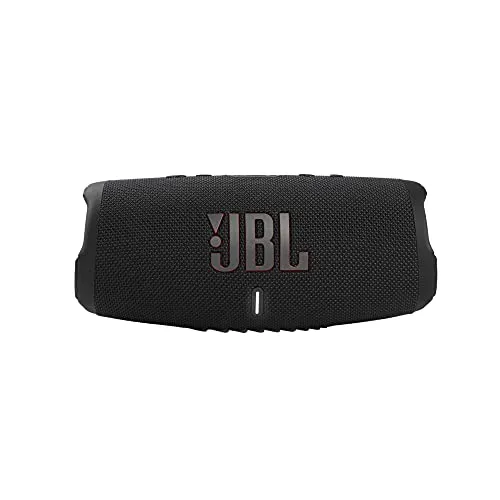
A loud, rugged, bass-forward portable speaker that nails the outdoor essentials — just treat its 20-hour rating as a best case.
Most portable speakers this size promise big sound and quietly under-deliver. The JBL Charge 5 is the exception that set the benchmark. That's why it still sells in huge numbers years after launch. It pairs a real bass-radiator design with IP67 ruggedness and a built-in USB power bank. The whole thing fits in a bag you can throw around and forget about. The question isn't whether it sounds good for its size, because it clearly does. It's whether it earns the premium over JBL's own Flip line and cheaper rivals. Here's where it excels, and the one area worth thinking hard about first.
Sound quality of the JBL Charge 5
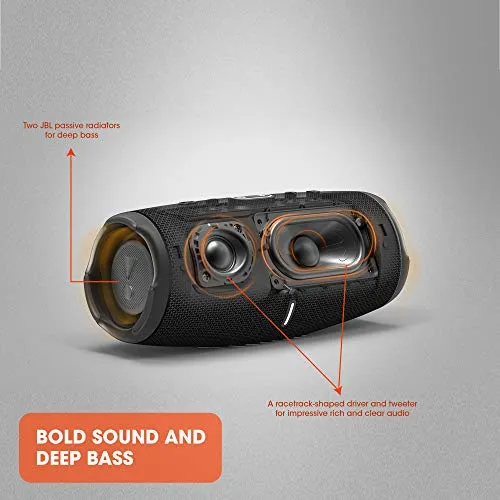
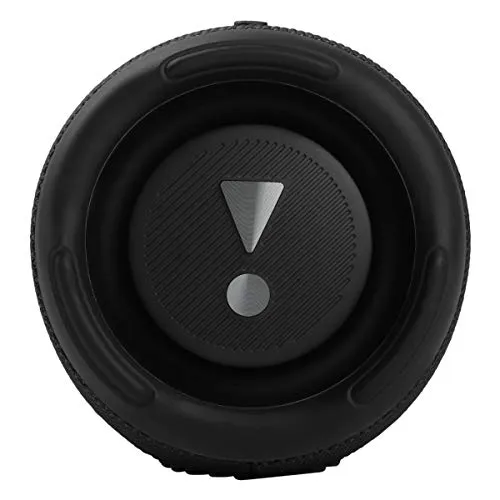
The JBL Charge 5 is built around a single racetrack driver and a separate tweeter. Dual passive bass radiators flank them, pulsing visibly at both ends. That combination is the whole story. The low end has real weight and punch. It avoids the thin, hollow thump you get from speakers that fake bass with EQ. At the default tuning it leans warm and bass-forward. Most listeners love that; a few find it heavy indoors.
Loudness is where it genuinely impresses. It fills a large room or a backyard without strain. It also stays clean up to roughly 75 to 80 percent of its range. Push past that ceiling, though, and the bass stops getting louder while the treble hardens. That limit is worth knowing if you plan to run it flat-out at a party. At sensible volumes, the sound is balanced, detailed, and bigger than the footprint suggests.
One honest note on tuning: this is a mono speaker. A single unit gives you no stereo separation. The soundstage is centered and direct rather than wide. For true left-right stereo, you pair two of them, which we'll come back to below. For podcasts, audiobooks, and casual music, the Charge 5 has more than enough range. Against a smaller sibling like the Flip, it trades a little portability for noticeably more low-end authority.
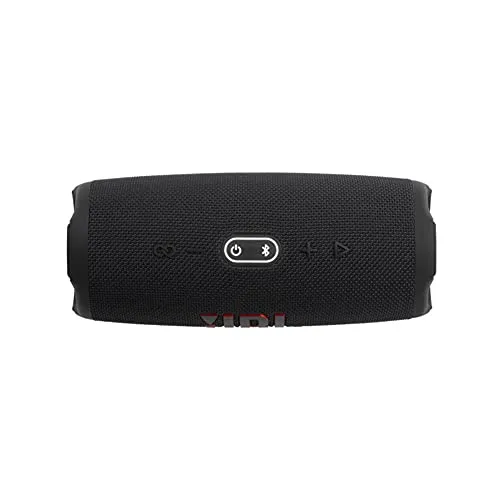
Design, build, and waterproofing
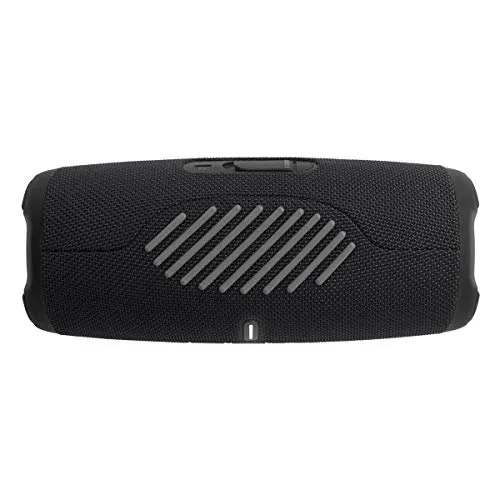
Physically, the Charge 5 hits the sweet spot between portable and substantial. It's about the length of a football, but slimmer. Tough fabric wraps the body, with rubberized caps at each end. It feels genuinely well made, with no creaks, no flex, and nothing cheap. At roughly 2.1 pounds, though, it isn't pocketable. A fair point hides in that weight: there's no carrying handle and no mounting points. As a result, most owners add a silicone sleeve with a strap to haul it or clip it to a bag.
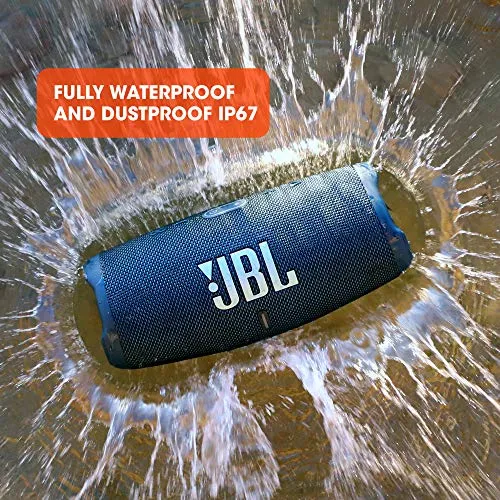
The ruggedness is the real selling point. It carries an IP67 rating under IEC 60529 for dust and water ingress. That means full dust resistance plus protection against temporary submersion, not just splash resistance on paper. In practice, you can use it confidently at the pool, on the beach, and out in the rain. The fabric shrugs off sand, and the rubber housing absorbs the occasional knock.
Two design details are worth flagging. First, the passive radiators on the end caps are exposed and ringed in softer silicone. A sharp object in a packed bag can nick them, so the case helps here too. Second, the USB-C port sits behind a rubber flap that keeps the waterproof rating intact. You do have to open that flap to charge the speaker or use the power bank. Keep it clean and dry before sealing it back up. Neither caveat undercuts a build that's clearly engineered for outdoor abuse.
Connectivity and PartyBoost pairing
Bluetooth here is version 5.1, and day to day it's reliable. Pairing is quick, the connection holds across rooms, and the range lets you walk well away without dropouts. There's no Wi-Fi and no aux input. This is a pure Bluetooth device. It won't slot into a wired setup or take a hardline from a turntable or mixer.
The headline feature is JBL PartyBoost, which links multiple compatible JBL speakers. Run two Charge 5 units and you finally get true stereo. You get separate left and right channels and a much wider, fuller soundstage. Still, two caveats matter before you count on it. First, PartyBoost only links current-generation PartyBoost speakers. An older Connect+ model like the Charge 4 will not pair with it. Second, multi-speaker stereo is driven from a phone or laptop. Getting a reliable pair running from a TV or an older Bluetooth source can be finicky. Very old sending devices may not sustain the link at all.
For single-speaker use, none of that matters, and pairing is set-and-forget. That's how most people listen anyway. If a stereo pair is your plan, buy two of the same generation and drive them from a modern phone. The experience is excellent that way. One more practical note: the speaker has no real speakerphone or voice assistant. It isn't the one to lean on for calls.
Battery life and the power bank
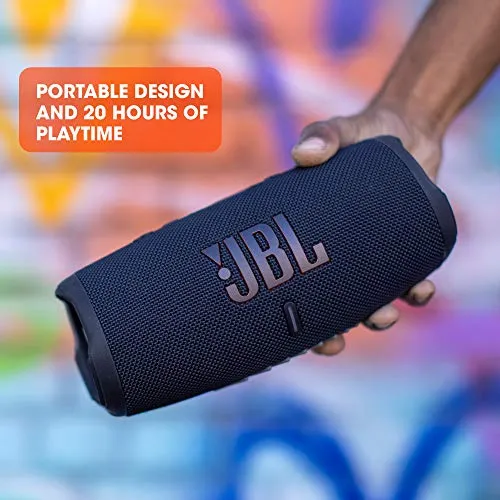
JBL rates the Charge 5 at up to 20 hours. When the battery is healthy, that figure is realistic. At moderate volume, it genuinely lasts through a long day with room to spare. The 7,500 mAh cell is large for this class, and a full USB-C recharge takes around four hours. As with any speaker, the rated number is a best case at modest output. Drive it hard near max volume and you'll see materially less, closer to the high single digits than to twenty.
The built-in power bank is a feature few rivals match. A USB-A output lets it top off a phone or small device away from an outlet. That's genuinely useful on a camping trip or a long day outdoors. It's a backup rather than a fast charger. Even so, it's the kind of practical extra that earns the Charge name.
The one area to go in clear-eyed about is long-term battery health. Like most speakers driven daily and charged constantly, units tend to lose runtime over time. A subset of owners see that decline become noticeable past the one-year mark. The good news is that the battery behaves well for the vast majority of normal use. Keeping it off a constant full charge helps. If you run it plugged in most of the time, this matters less. If you need years of unplugged 20-hour stamina, set expectations accordingly. For trips, the pool, and weekend listening, battery life is a strength far more often than a sore point.
App, EQ, and everyday controls
The JBL Portable app handles firmware updates and a basic three-band equalizer. You get bass, mid, and treble sliders, not a full parametric or graphic EQ. It does enough to nudge the sound warmer or brighter. Don't expect to reshape the tuning or carve out a problem frequency, though; the range is modest. For most people, the default voicing is the right call anyway.
On-speaker controls are simple and well placed. You get power, Bluetooth, volume, and a multifunction play/pause that also skips forward. The notable omission is a previous-track or replay control. There's no way to jump back a song from the buttons themselves. It's a long-running quirk across JBL's lineup, and it's mildly annoying if you control playback from the speaker. A firmware update could fix it, and hasn't.
Ecosystem-wise, keep expectations grounded. This is a Bluetooth music speaker first and foremost. There's no Wi-Fi streaming, no native voice assistant, and no dependable speakerphone. If you want Alexa or Google built in, or multi-room Wi-Fi audio, this isn't that product. As a grab-and-go speaker that plays music loudly and reliably, though, the feature set is tight and sensible rather than padded with gimmicks.
Value and how it compares
At its premium-portable price point, the Charge 5 isn't the cheapest route to loud. Plenty of budget speakers undercut it. What you pay for is the combination. You get the bass-radiator sound, the IP67 build, and the long battery. Add the power bank, plus JBL's reliability and resale value. Together, that bundle is hard to match for the money. That's why it stays a default recommendation.
Within JBL's own range, the decision is mostly about size. Step down to the Flip 7 for a lighter, more pocketable speaker with less low-end muscle. Step up to the Xtreme 4 for bigger, room-shaking output and a carrying strap. The trade-off there is real size and weight. The newer Charge 6 is the direct successor. It's a sensible pick if you want the latest version, though the core experience is very close.
Against outside competition, the obvious rival is the Bose SoundLink Flex. It trades some bass impact for a more refined, balanced tuning, and it includes a usable speakerphone. Anker's Soundcore Boom 2 comes at it from the value angle, leaning into heavy bass and party features for less. The Charge 5 sits in the middle of all of them. It's louder and bassier than the Bose. It's also more polished than budget rivals and a safer long-term bet than no-name options. For one rugged speaker to cover the pool, the campsite, and the backyard, it's still the easy answer.
Pros: What we liked
- Pro: Bass-radiator design delivers real low-end weight, not EQ-faked thump
- Pro: Gets genuinely loud and stays clean up to roughly 75-80% volume
- Pro: IP67 dust and waterproofing holds up to real pool, beach, and rain use
- Pro: Up to 20 hours of playtime when healthy, plus a USB power bank for your phone
- Pro: Rugged, well-built, and travel-ready; PartyBoost links JBL speakers for true stereo
Cons: What could be better
- Con: The 20-hour rating is a best case; runtime drops at high volume and fades with heavy long-term use
- Con: A single unit is mono with no handle or mounting points — a case and a second speaker round it out
- Con: App EQ is a basic 3-band, and there's no previous-track control on the speaker itself
Best For
- Outdoor, pool, and backyard listeners who want volume and IP67 durability
- Travelers and campers who value long battery plus a phone-charging backup
- Anyone upgrading from a smaller speaker who wants more bass and loudness
- JBL owners who want to PartyBoost multiple speakers together for stereo
Not Ideal For
- Listeners who need true stereo from one unit or want to wall-mount a speaker
- Buyers who rely on speakerphone, voice assistants, or fine-grained EQ control
- Heavy daily users expecting the full 20-hour rating to hold for years
| Specification | Details |
|---|---|
| Output Power | 40W |
| Audio Configuration | Racetrack driver + tweeter + dual passive bass radiators (mono) |
| Battery Life | Up to 20 hours rated; less at high volume |
| Battery / Charging | 7,500 mAh; USB-C, ~4 hours; USB-A power-bank output |
| Waterproofing | IP67 (dustproof and waterproof) |
| Bluetooth | 5.1 (no Wi-Fi, no aux input) |
| Weight | ~2.1 lb (0.96 kg) |
| Multi-Speaker | JBL PartyBoost (pairs with current PartyBoost speakers) |
Alternatives Worth Considering
Final Verdict
The JBL Charge 5 earns its popularity by nailing the fundamentals a portable speaker needs. You get big, clean, bass-forward sound, real IP67 durability, genuine loudness, and a power bank that pulls its weight. It's mono from a single unit, the app EQ is basic, and the 20-hour rating is a best case that fades with heavy use. None of that undermines a speaker that does the core job better than most. For outdoor, pool, and travel use, it stays one of the most reliable picks in its class. Buy a silicone case with it, and add a second unit if you want true stereo.
Frequently Asked Questions
Does the JBL Charge 5 really last 20 hours?
It can at moderate volume when the battery is healthy. Played loud, expect closer to 8-12 hours, and runtime gradually drops with heavy long-term use.
Can you pair two JBL Charge 5 speakers for stereo?
Yes. Using PartyBoost from a phone or laptop, two units give true left-right stereo and a much fuller sound. Drive them from a modern Bluetooth source for the most reliable link.
Will the Charge 5 pair with a JBL Charge 4?
No. The Charge 5 uses PartyBoost while the Charge 4 uses the older Connect+ system, so the two generations can't link together.
Is the Charge 5 waterproof enough for the pool?
Yes. Its IP67 rating means full dust resistance and protection from temporary submersion, so pool, beach, and rain use are all fine.
Can you use the JBL Charge 5 for phone calls?
Not really. It's a music-first speaker without a dependable speakerphone or voice assistant, so it isn't the right pick for calls or video meetings.
The Verdict
A loud, rugged, bass-forward portable speaker that nails the outdoor essentials — just treat its 20-hour rating as a best case.