JBL PartyBox 100 Review: Backyard-Filling Bass, Mic Input
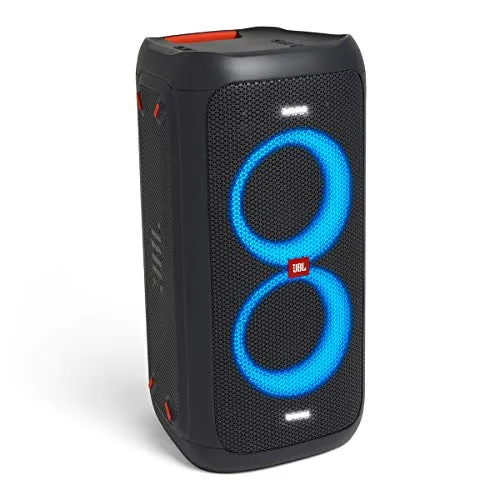
Backyard-filling bass, a light panel you can dial down and inputs for a mic or a guitar, in a cabinet built to sit still. Longevity is the one reservation, and it is real.
The JBL PartyBox 100 is not a speaker you throw in a bag. At 21.4 pounds and 26 inches across, it takes a corner of a room and holds it. It will still be sitting there next summer. That puts it in the equipment class, and equipment gets judged on three questions. How much ground does it cover? What does it cost you to move? And will it still be working in two years?
The first is settled fast: it plays loud. Its low end carries real weight, and the sound holds together as the dial climbs. A light panel across the front adds to that, and it stays yours to set. The third question is the one that decides this purchase. A box this size is bought to be kept. Some of these do not last the way the cabinet suggests they will.
How far the JBL PartyBox 100 carries
Loudness is the first thing anyone asks about a box this size, and the answer comes with an edge. Indoors, the JBL PartyBox 100 fills a house without being asked twice. Outdoors, it covers a backyard, and for house parties, cookouts and a yard full of people it does the job convincingly.
Push past that and the edge shows. In genuinely open ground it stops sounding big, and starts sounding like a speaker some distance away. At this end of the market, that lands harder than it would elsewhere. This is a box that owns a space; it does not throw sound across one. My read of the split is that both camps are describing the same speaker from different distances.
The low end is why people keep it. Bass on the JBL PartyBox 100 is heavy and clean at the same time. It stays composed as the volume climbs, and nothing turns to mush at the top of the dial. A stepped bass boost sits on top of that, and the steps do real work. Its lowest step adds plenty for a room, and its top step shakes walls, which is more than a living room asks for. Treat the boost as a room control you set for the space you are in. Crank the volume and the top end stays crisp, the mix keeps its shape all the way up, and that composure is the more impressive piece of engineering here.
Where a 21.4-pound speaker ends up
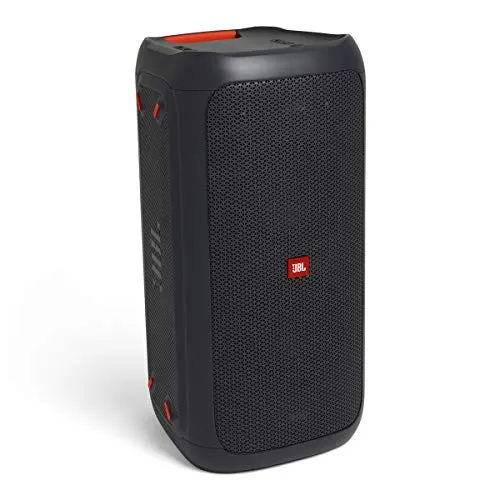
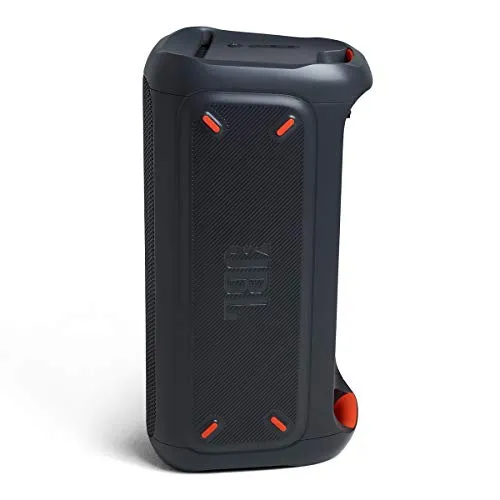
The JBL PartyBox 100 measures 26.14 by 13.86 by 14.02 inches and weighs 21.4 pounds. Read those numbers as furniture. One person can carry it, and it does travel — to the yard, into a car, out to a wedding reception. You carry it deliberately, though, and you want somewhere to set it down at the other end. Between events it lives somewhere, and where that somewhere is deserves a thought before the box arrives. A cabinet this wide wants a surface with room around it and an outlet within reach. That constraint outlives the party.
The build is the good news. The cabinet is solid, and its solidity is the least controversial thing about this product. That matters more than it sounds. A case this convincing sets an expectation the electronics inside do not always meet.
Across the front is the lighting JBL leans on hardest in its own copy. The claim is a full-panel light show. In a room it amounts to a handful of selectable patterns, and which one runs stays yours to decide. That is the right amount of say to have over a feature like this. It is a pleasant thing to own. It should not be the reason you buy. On a speaker this good at the sound part, it does not need to be.
Running it away from a wall
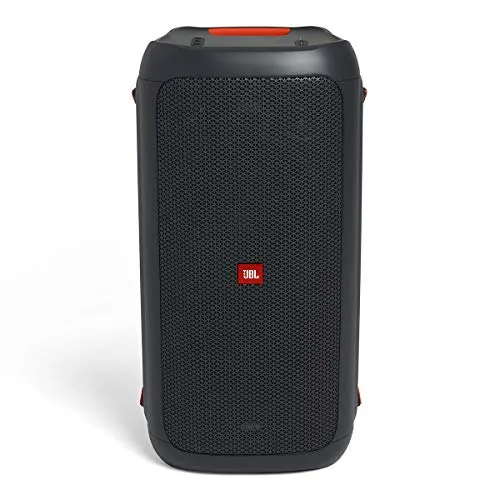
There is a rechargeable battery in the JBL PartyBox 100. Held around the middle of its range, it will see out a long evening comfortably. Some charges are gone inside a few hours, which is short enough to catch out anyone planning a whole day on one charge. My own reading of the gap is that it comes down to how hard the speaker is driven.
Plan around the low number. If the event runs long, or loud, put it on wall power and let the battery cover the stretch where no outlet is available. For most parties, which happen within reach of a wall, that is a small limitation. For a beach, a park or anywhere the power stops at the parking lot, it is a real one.
There is a small discipline that comes with that: charge it the night before an event, and work out where the nearest outlet is when you choose the spot for it. Neither is a hardship, and together they decide whether the speaker plays all evening or goes quiet while people are still dancing.
How well it holds up
Here is the reservation, and it earns the space: some JBL PartyBox 100 units stop working. The failures come in more than one form and end the same way. Audio vanishes while the speaker still powers up. A unit refuses to come on at all. A box switches itself on in an empty room and off again an hour later. Some of it lands inside the first month. Some lands in the second year, past the point where a store will take it back.
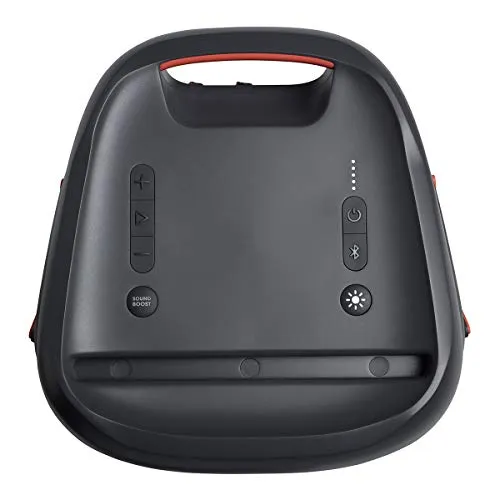
The power control has its own set of complaints, separate from an outright failure. A press that gets no response. A speaker that comes on half a minute after you gave up on it. One that will not switch off when told. The unit still plays; the control in front of it has stopped being trustworthy. On a speaker you carry to other people’s houses, that is more than a footnote.
Water belongs in the same section. Keep it dry: water getting in at the top of the cabinet, where the controls sit, is one way these end up dead. A covered patio is a different proposition from an open one, so treat it as an indoor speaker that visits the outdoors on good days.
So give it a proper workout inside the return window, at the volume you intend to use, and buy from a seller that makes a return simple. Most of these speakers are fine. The ones that are not tend to announce themselves early, or long after the paperwork has run out. At this end of the market that is the precaution I would take, and it costs nothing.
One speaker or two
Buying a second one is the obvious upgrade, and it works. Two linked together give real stereo separation and more sound than one box makes. For a room or a yard that a single unit only just covers, that is the answer this design offers. It is a thing to weigh before the first purchase. It changes the arithmetic on what one unit is for.
The link itself is where some of the shine comes off. Getting two units paired, and keeping them paired, takes more patience than pairing a phone. A set can fall out of sync, one speaker running behind the other, and even a small offset makes music unlistenable. The cure is simple and irritating: switch both off, pair them again, carry on.
Pairing to a phone is the easy half of this. The JBL PartyBox 100 connects quickly and without ceremony. That matters at a party, where the phone in charge of the playlist changes hands every few songs.
Plugging in a mic or a guitar
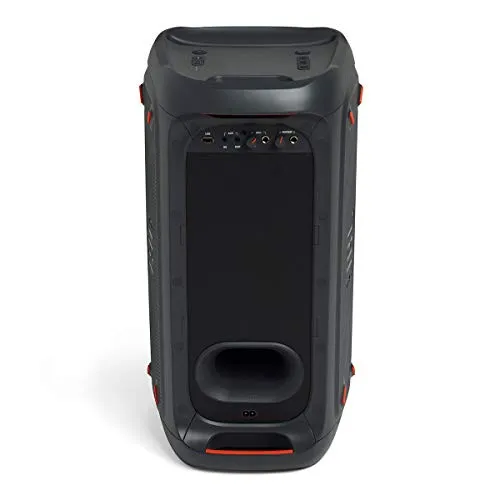
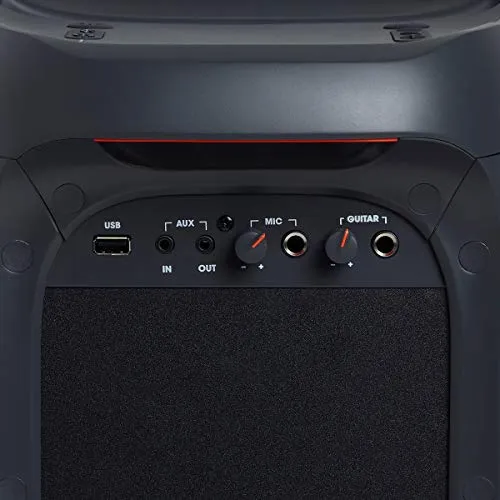
The listing gives this speaker a mic input and a guitar input, and that pair is what turns it from a speaker into something you can perform through. Plug a microphone in and a karaoke night needs nothing beyond the mic. Plug a guitar in and the speaker is the amplifier for a backyard set. Both are uses that justify the size, and a speaker you have to carry deliberately should do more than play a playlist.
JBL’s own wording is that you plug in your mic or your guitar, and that possessive is doing work. The speaker supplies the input and the amplification; the microphone is your side of the purchase.
Add the inputs to the output and the picture resolves: this is party equipment that happens to take a playlist. Read it that way and most of what it asks of you makes sense. The weight, the size, the outlet you want within reach — all of it follows. Judged as a Bluetooth speaker, the JBL PartyBox 100 looks enormous. Judged as party equipment, it looks about the right size for the job.
Pros: What we liked
- Pro: Heavy, clean bass that keeps its composure as the volume climbs
- Pro: Covers a house indoors and a backyard outdoors without thinning out
- Pro: A stepped bass boost that works as a genuine room control
- Pro: Mic and guitar inputs make it a karaoke rig or the amp for a live set
- Pro: Two units link for real stereo separation, and the pair is a genuine step up
Cons: What could be better
- Con: Some units stop working outright, inside the first month or well past the first year
- Con: The power control is the weak point: presses that get no response, and units that switch themselves on or off
- Con: Battery runtime on one charge can fall to a few hours
- Con: Linking two units takes patience, and a pair can fall out of sync until both are re-paired
Best For
- Hosts filling a house or a backyard who want the music to carry to the edges of it
- Anyone who wants bass with physical weight from a box one person can still move
- Anyone running a karaoke night or a small live set, where the inputs earn their place
- Buyers happy to add a second unit later and run the pair for bigger rooms
Not Ideal For
- Anyone who needs a speaker to travel light — this one moves deliberately and needs somewhere to land
- Listeners expecting sound to carry right across genuinely open ground
- Anyone whose speaker has to live outdoors and take whatever weather arrives
| Specification | Details |
|---|---|
| Weight | 21.4 lb |
| Dimensions | 26.14 x 13.86 x 14.02 in |
| Instrument inputs | Mic input and guitar input |
| Wireless | Bluetooth streaming |
| Power | Rechargeable battery |
| Lighting | Full-panel lighting effect (JBL's description) |
| Finish | Black |
| Released | April 2019 |
| Model code | JBLPARTYBOX100AM |
Alternatives Worth Considering
Final Verdict
Seven years after it first went on sale, the PartyBox 100 still does the job it was built for. It does it with more authority than its age suggests. The bass has real weight, and the volume covers the spaces people throw parties in. Mic and guitar inputs give it a second job entirely. Its light panel is a pleasant extra and nothing more.
The reservation has nothing to do with the sound. Some of these stop working, and the power switch is the least trustworthy thing on the box. Both of those matter more when the box costs what this one costs. My hesitation is exactly that wide and no wider. I rate this speaker highly on what it does, and a notch lower on how long it keeps doing it.
Frequently Asked Questions
How much does the JBL PartyBox 100 weigh?
21.4 pounds, in a cabinet measuring 26.14 by 13.86 by 14.02 inches. One person can move it, but it is a carry you plan rather than a grab-and-go.
Is it loud enough to use outdoors?
For a backyard, a driveway or a cookout, comfortably. In genuinely open ground it stops feeling big. This is not the speaker for anything that has to reach the far side of a field.
How long does the battery last on one charge?
Around the middle of its range, a long evening. Some charges are gone inside a few hours. For a long fixed event, keep it on wall power.
Can you link two of them together?
Yes, and a pair is a real step up on one for stereo separation and coverage. Pairing them takes patience, and a set can fall out of sync; the cure is to switch both speakers off and pair them again.
Can you plug in a microphone or a guitar?
Yes. It has a mic input and a guitar input; the speaker supplies the amplification, and the microphone or instrument is your side of the purchase.
The Verdict
Backyard-filling bass, a light panel you can dial down and inputs for a mic or a guitar, in a cabinet built to sit still. Longevity is the one reservation, and it is real.