JBL Clip 5 Review: IP67, USB-C, AuraCast Stereo
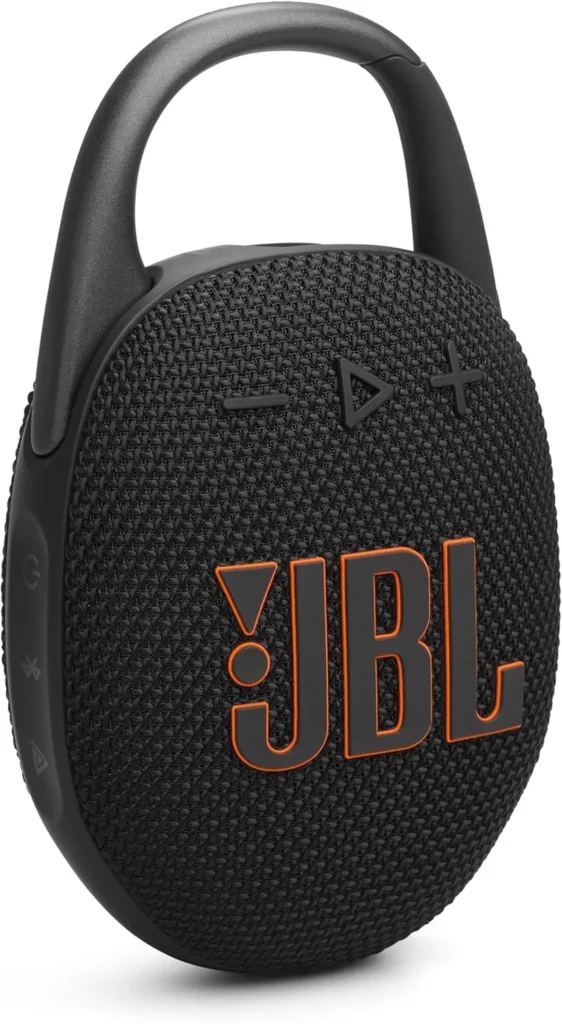
A genuine sound-quality step up from the Clip 4 with AuraCast stereo pairing and real IP67 durability — held back only by an occasional random-shutoff quirk.
The ultra-portable speaker category is where JBL built its consumer audio empire. The JBL Clip 5 is the latest iteration of a formula that started with the original Clip in 2014. Headline changes versus the Clip 4: AuraCast stereo pairing, a redesigned carabiner, USB-C charging. Notably, the driver-and-radiator combination has been retuned to push bass response harder. Whether those changes justify the upgrade depends on what you already own. It also depends on how much you care about ecosystem features. For anyone coming to the Clip line fresh, this is the strongest entry yet. One caveat worth knowing before you decide: the auto-shutoff quirk affecting a minority of units.
Sound quality of the JBL Clip 5
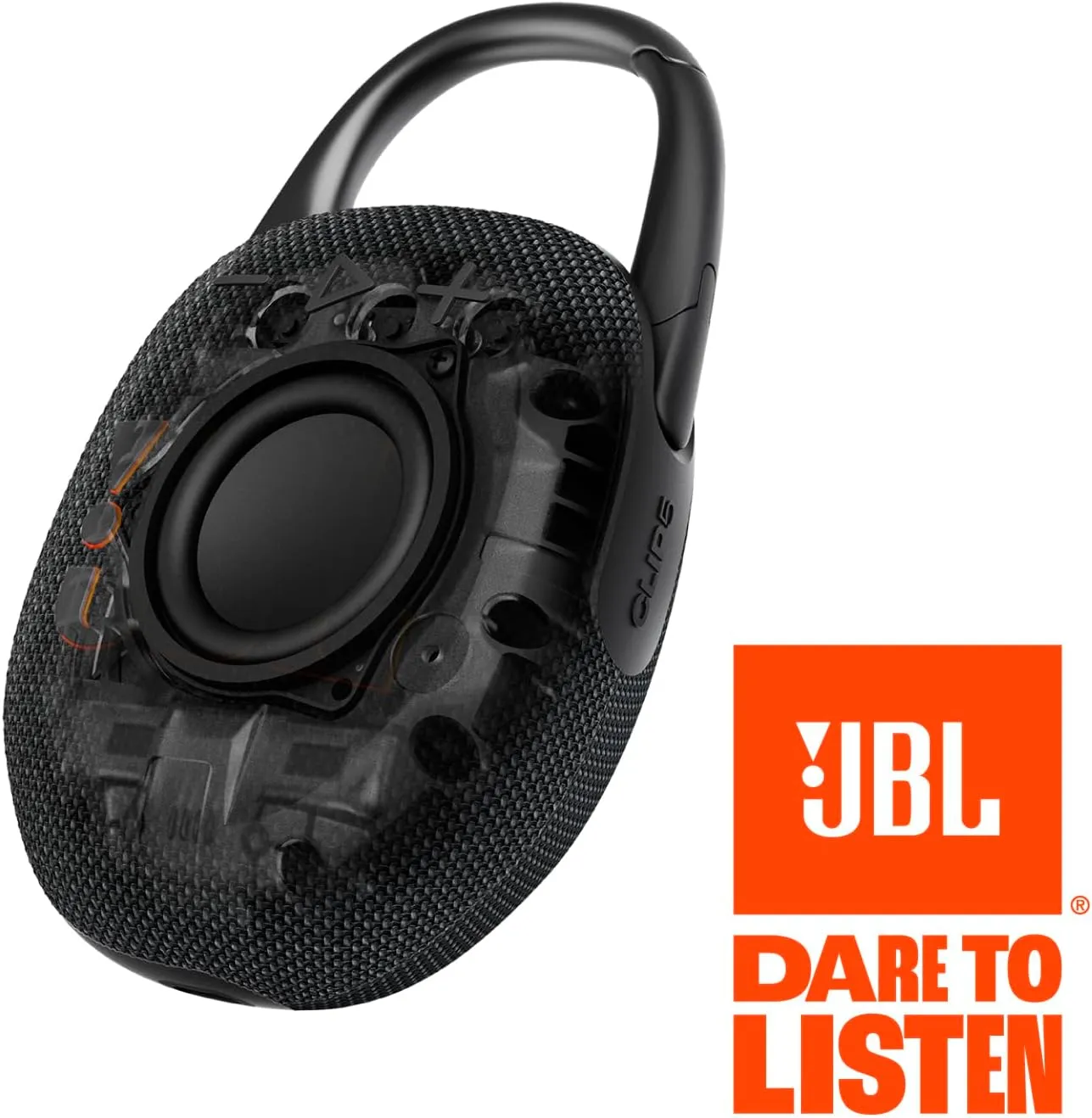
The JBL Clip 5 uses a single full-range driver paired with a passive radiator. Architecturally, it matches the Clip 4. JBL retuned the crossover, however, to push bass response noticeably harder. This produces a sound signature that leans warm and bass-forward. It's particularly noticeable on tracks with strong sub-bass content. For most listeners that translates to more presence in casual outdoor listening. Anyone wanting neutral reproduction, however, should look elsewhere. Tuning here is unapologetically consumer-oriented.
At moderate volume the audio is clean, surprisingly full, and stereo-image-coherent for a single-driver design. Vocals sit well in the mix. The passive radiator does meaningful work extending the perceived low-end. It reaches well below what a driver in this enclosure should physically deliver. Push the volume past roughly 80%, however, and the mids start losing definition against the bass. Vocals get masked on busy tracks. Acoustic guitars lose attack. That's a physical limitation of the form factor rather than a tuning problem. It does mean the Clip 5 isn't the speaker for vocal-forward mixes played loud.
Against the Clip 4, the upgrade is real but not transformative. Bass extends slightly deeper, max volume is a touch higher, and the overall presentation feels fuller. Notably, the JBL Portable app's custom EQ can dial back the bass for listeners who prefer a flatter response. This addition wasn't available on the Clip 4 at launch. Already own a Clip 4 with sound you're happy with? Audio improvement alone doesn't justify the upgrade. The case for the JBL Clip 5 lives elsewhere in the spec sheet.

Build quality and waterproofing
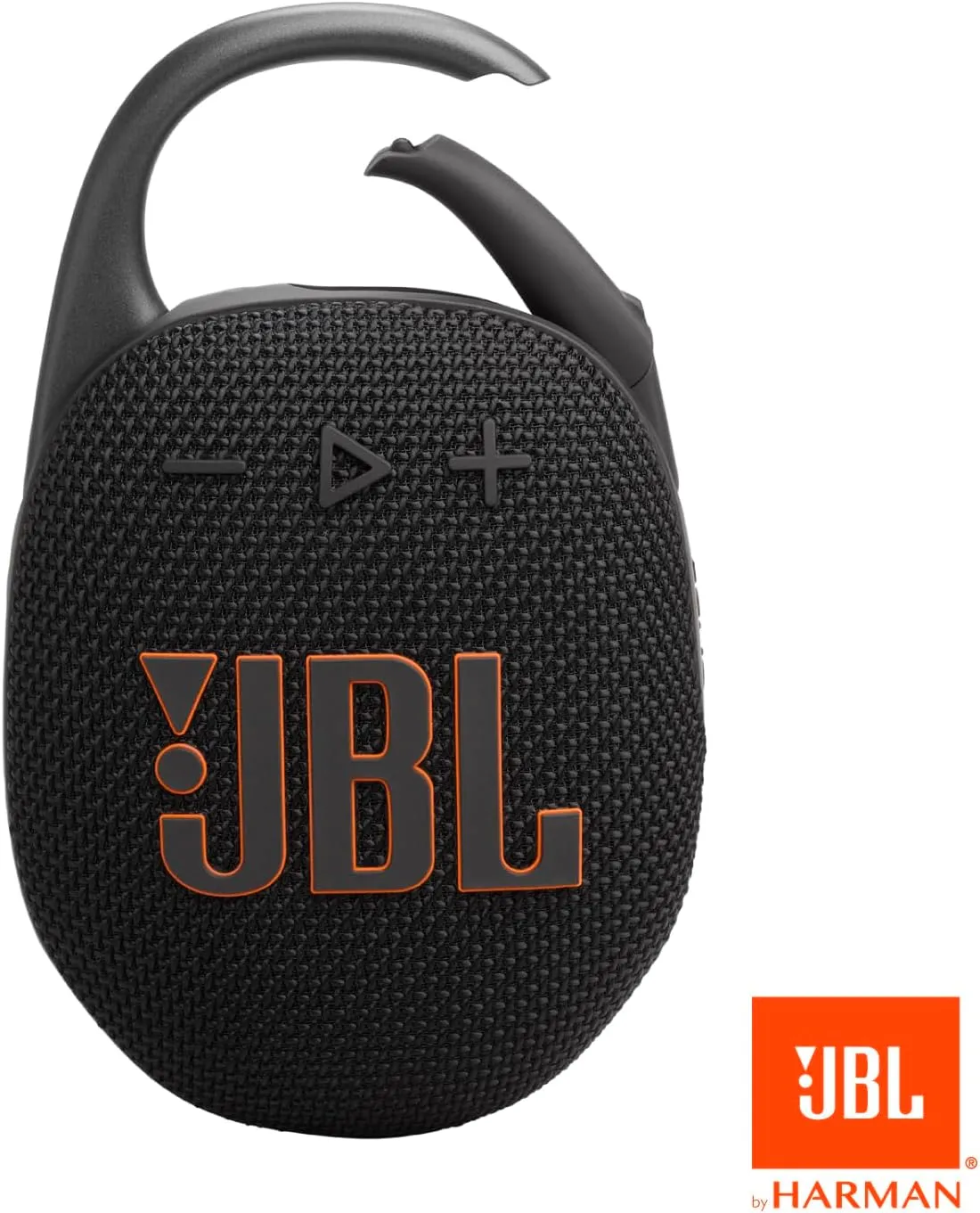
The redesigned carabiner is the headline physical change, and it's a meaningful improvement. JBL switched from a spring-loaded hinge to a fully integrated one. It also opens wider. Clipping onto backpack straps, cooler handles, and bike frames is faster and more secure than on the Clip 4. The metal portion of the loop has a more substantial feel. Plastic on the mating surface, however, is the part to watch over multi-year use. A small but recurring cluster of units develops carabiner cracks past the six-month mark. Heavy daily clipping cycles seem to be the trigger. For most owners that's a non-issue. Anyone planning to clip and unclip daily should consider it.
IP67 dust and water resistance holds up in real use. Pool drops, beach sand, light rain, and even brief shower mounting are all handled without complaint. JBL rates the speaker for official IP67 protection per IEC 60529. The standard covers 30 minutes of submersion in up to one meter of water. That's meaningfully more protection than the older Clip 3's IPX7-only rating, which didn't cover dust ingress.
One design quirk worth flagging: the egg-shaped body means the speaker cannot stand on a flat surface. It rests on its side instead. For poolside, hanging-from-a-carabiner, or bag-attached use this is fine and arguably preferable. On a kitchen counter or desk, however, it rolls. Third-party silicone stands exist but partially cover the driver, which compromises sound. JBL's design choice clearly prioritizes the clip-on use case at the cost of tabletop usability.

Connectivity and AuraCast
Bluetooth 5.3 pairs quickly and maintains a stable connection at typical indoor distances of 10-15 meters. Range drops outdoors. The typical 8-10 meter line-of-sight is normal for the protocol and form factor. The standout connectivity feature is AuraCast support, which replaces the PartyBoost protocol used in earlier JBL portables.
AuraCast lets two Clip 5 units pair for true stereo. It can also sync any number of AuraCast-capable JBL speakers for simultaneous playback. The critical compatibility note: AuraCast and PartyBoost are not cross-compatible. Older JBL speakers with PartyBoost won't pair with the JBL Clip 5. That includes the Clip 4, Flip 5, Charge 4, and Xtreme 3. The break covers stereo and multi-speaker playback across generations. This is a hard limit in the JBL ecosystem and worth confirming before you upgrade. For new buyers building a system from scratch, AuraCast is the better protocol and the path forward. For anyone upgrading partway through an existing JBL setup, however, it's a real frustration.
The speaker also lacks a built-in microphone. It cannot be used for speakerphone calls — voice memos and calls have to stay on your phone. That's a small omission. It puts the Clip 5 behind the Bose SoundLink Micro at a similar form factor. The Bose does include a microphone. Multipoint Bluetooth — connecting to two source devices simultaneously — is also absent. For single-source listeners that's fine. For anyone juggling a phone and laptop, however, manual re-pairing is required each time you switch devices.
Battery life and reliability
JBL rates battery life at 12 hours. The real-world picture is more variable than that headline suggests. At moderate volume — roughly 50-60% — the JBL Clip 5 holds 10-11 hours consistently. Higher volumes with bass-heavy content drop runtime to 6-8 hours. Pushing to near-maximum volume with Playtime Boost active, expect closer to 4-5 hours of continuous use. The 12-hour claim is achievable, but only at modest listening levels. That's a normal pattern for the category, though worth setting expectations around.
Charging moves to USB-C, finally. The Clip 3 and earlier used Micro-USB, and the upgrade is overdue. A full charge from empty takes roughly 3 hours, which is on the slow side for the battery capacity. JBL ships a short cable, around 25 centimeters, which constrains plugged-in use. Any standard USB-C cable works as a replacement. Notably, there's no battery percentage readout on the speaker itself. The app shows it, but only when the speaker is connected to your phone.
One reliability footnote needs flagging directly. A small but recurring cluster of units exhibits an intermittent auto-shutoff issue. Affected speakers power themselves off mid-playback even with the auto-off setting disabled in the app. This isn't a battery problem. It's a firmware or hardware quirk affecting a specific subset of devices. Symptoms typically appear within the first weeks of ownership. Resets and app interventions don't recover affected units. JBL's warranty covers replacement, and the replacement units generally don't repeat the behavior. The pattern suggests a manufacturing tolerance issue rather than a fleet-wide defect.
JBL Portable app and ecosystem features
The JBL Portable app is optional but unlocks meaningful functionality. It includes a custom graphic EQ with preset options and AuraCast multi-speaker management. Firmware updates and finer control over the auto-shutoff timer are also available. The app is well-designed and pairs reliably. It also doesn't gate critical features behind login — the speaker works fully without ever installing it. That's the right approach at this price point. Forced app dependency is increasingly common and increasingly resented in this category.
The integrated Playtime Boost mode is a notable addition. It automatically reduces bass response and lowers maximum output to extend battery life when activated. In practice, the mode adds about 1-2 hours of runtime at the cost of a thinner low-end. It's useful for a long day at the beach, but not something you'll leave on for casual indoor listening.
For ecosystem buyers, the AuraCast feature is the main pull on the JBL Clip 5. Pairing two units in stereo dramatically improves soundstage and separation. Best results come with the speakers placed 1.5-2 meters apart. The same pairing works with other AuraCast-capable JBL products. Newer models like the Flip 6, Charge 6, and Boombox 3 all join the same building-block portable audio system. As the satellite in such a setup, the Clip 5 adds spatial coverage without overwhelming a larger primary speaker. Single-speaker users, however, will find this whole feature category largely irrelevant. Value then shifts toward more straightforward alternatives in the same form factor.
Value and the upgrade question
At its typical sub-$80 retail price, the JBL Clip 5 competes directly with the Bose SoundLink Micro. It also competes with the previous-generation Clip 4, which remains widely available at a discount. Against the Bose, JBL wins on battery life, AuraCast stereo pairing, and ecosystem breadth. The Bose, in turn, holds the edge on tighter bass tuning, built-in microphone, and overall build polish. Sound character is the deciding factor between the two. The Bose is the more neutral listen, the JBL the more energetic.
Against the older Clip 4, the upgrade case is narrower. AuraCast is the meaningful difference if you're building or already own a multi-speaker setup. For single-speaker use, however, the Clip 4 remains a strong option at a lower current price. It delivers very similar sound quality and the same IP67 durability. The carabiner redesign is a genuine improvement but not enough alone to justify replacing a working Clip 4.
For anyone coming from a Clip 3 or earlier, the upgrade is straightforward. USB-C, AuraCast, and the refined carabiner together easily justify the move. For Clip 4 owners with no PartyBoost ecosystem already invested, however, it's a closer call worth thinking through. The speaker earns its place in the JBL lineup. Whether it earns a place in your bag depends on what's already there.
Pros: What we liked
- Pro: AuraCast stereo pairing works reliably with a second Clip 5 unit
- Pro: IP67 rating holds up in real pool, sand, and rain exposure
- Pro: Redesigned carabiner opens wider and feels more secure than the Clip 4
- Pro: Bass response noticeably fuller than the Clip 4 thanks to retuned crossover
- Pro: USB-C charging finally replaces the Clip 3's Micro-USB port
- Pro: JBL Portable app adds a custom EQ without gating core functionality
- Pro: Wide color range plus a meaningful battery-extending Playtime Boost mode
Cons: What could be better
- Con: Random auto-shutoff issue affects a small but consistent cluster of units
- Con: AuraCast is not backward-compatible with older PartyBoost JBL speakers
- Con: No built-in microphone and no multipoint Bluetooth for source switching
- Con: Egg-shaped body cannot stand flat on a tabletop without a third-party stand
Best For
- Hikers, cyclists, and travelers wanting clip-on portable audio
- New JBL ecosystem buyers building toward a multi-speaker AuraCast setup
- Pool, beach, and outdoor users who need genuine IP67 durability
- Listeners coming from a Clip 3 or earlier who want a modern feature set
Not Ideal For
- Existing JBL owners with a PartyBoost ecosystem of Flip 5s or Charge 4s
- Buyers wanting a neutral sound signature with vocal-forward clarity
- Anyone needing speakerphone functionality from their portable speaker
| Specification | Details |
|---|---|
| Driver | Full-range driver + passive radiator |
| Output Power | 7W RMS |
| Battery Life | 12 hours rated; 10-11 hours real-world at moderate volume |
| Waterproofing | IP67 (dust + water; 1m for 30 min) |
| Bluetooth | 5.3 with AuraCast |
| Charging | USB-C, ~3 hours full charge |
| Weight | 285g |
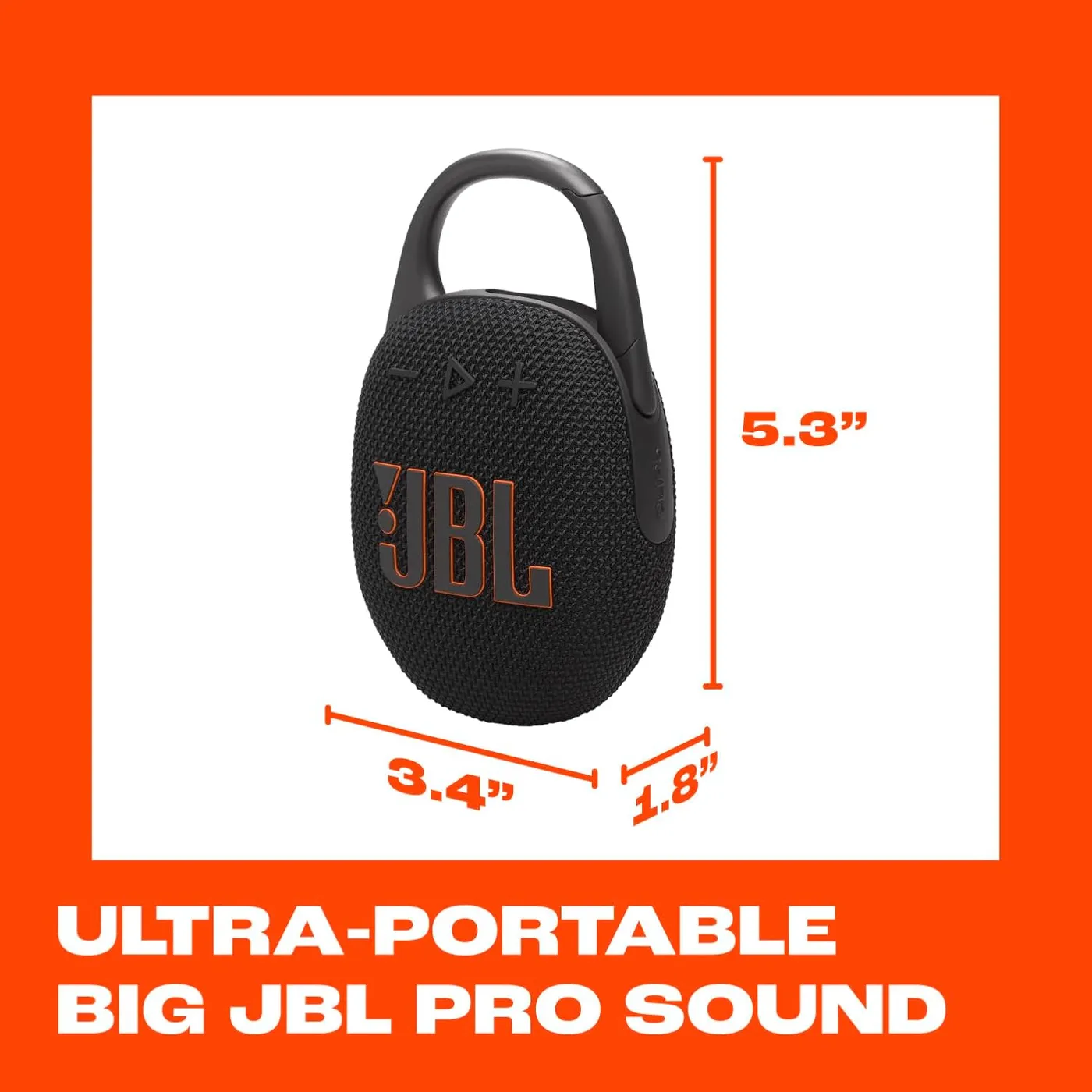
| Dimensions | 3.4"D x 1.8"W x 5.3"H |
Alternatives Worth Considering
Final Verdict
The JBL Clip 5 hits the marks that matter for an ultra-portable speaker. Real IP67 durability, dependable Bluetooth 5.3, and a meaningfully redesigned carabiner all deliver. AuraCast adds future-proofing for anyone planning a multi-speaker JBL setup. One issue is serious enough to flag: the auto-shutoff cluster affecting a minority of units. It's covered by JBL's warranty, but worth knowing before purchase. Bass-forward tuning will polarize listeners who prefer neutral reproduction. A missing microphone keeps the Bose SoundLink Micro relevant for anyone who needs speakerphone functionality. Coming from a Clip 3 or earlier, it's an easy upgrade recommendation. From a Clip 4 it's primarily a value question. For a first JBL portable in this form factor, it's the obvious choice.
Frequently Asked Questions
Will the JBL Clip 5 pair with my older JBL Flip 5 or Charge 4?
No. The Clip 5 uses AuraCast, while the Flip 5 and Charge 4 use PartyBoost. The two protocols are not cross-compatible, so the speakers cannot pair for stereo or multi-speaker playback.
Is the carabiner durable enough for daily clipping?
For most users, yes. The redesigned hinge is sturdier than the Clip 4's, but the plastic mating surface can develop cracks past six months under heavy daily clipping cycles. JBL's warranty covers it if it does.
Can the JBL Clip 5 be used in the shower?
Yes. The IP67 rating covers immersion up to one meter for 30 minutes, which is comfortably above shower-grade water exposure. Direct hot steam over long sessions isn't specifically rated, but in practice it's fine.
How does battery life compare to JBL's 12-hour claim?
At moderate volume, real-world battery lands around 10-11 hours. At high volume with bass-heavy music, runtime drops to 6-8 hours. The 12-hour figure is achievable only at modest listening levels.
Does it have a microphone for phone calls?
No. The Clip 5 has no built-in microphone, so it cannot be used as a speakerphone. Voice calls have to be handled on your phone directly.
The Verdict
A genuine sound-quality step up from the Clip 4 with AuraCast stereo pairing and real IP67 durability — held back only by an occasional random-shutoff quirk.