Beats Pill 2024 Review: Big Bass, Fiddly Controls
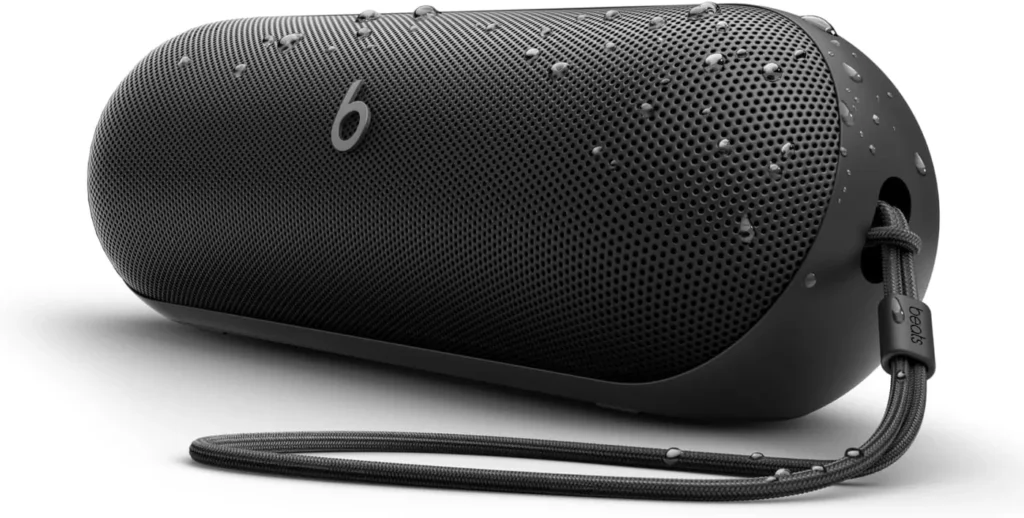
A loud, bass-forward portable that's a genuine steal on sale - held back by clumsy power controls and a tuning you can't adjust.
If you owned the original Beats Pill, the Beats Pill 2024 will surprise you. It grew up, literally. This generation is larger, heavier, and a lot louder than the slim model it replaces. It also finally switches to USB-C. The bigger story, though, is the sound. You get a deep, bass-forward signature. It fills a room far beyond what the compact footprint suggests. Still, everything good here comes with a small asterisk. The controls take some learning. The tuning is fixed, with no real EQ. And the value depends heavily on the price you pay. That last point matters more than you might expect.
Sound quality of the Beats Pill 2024
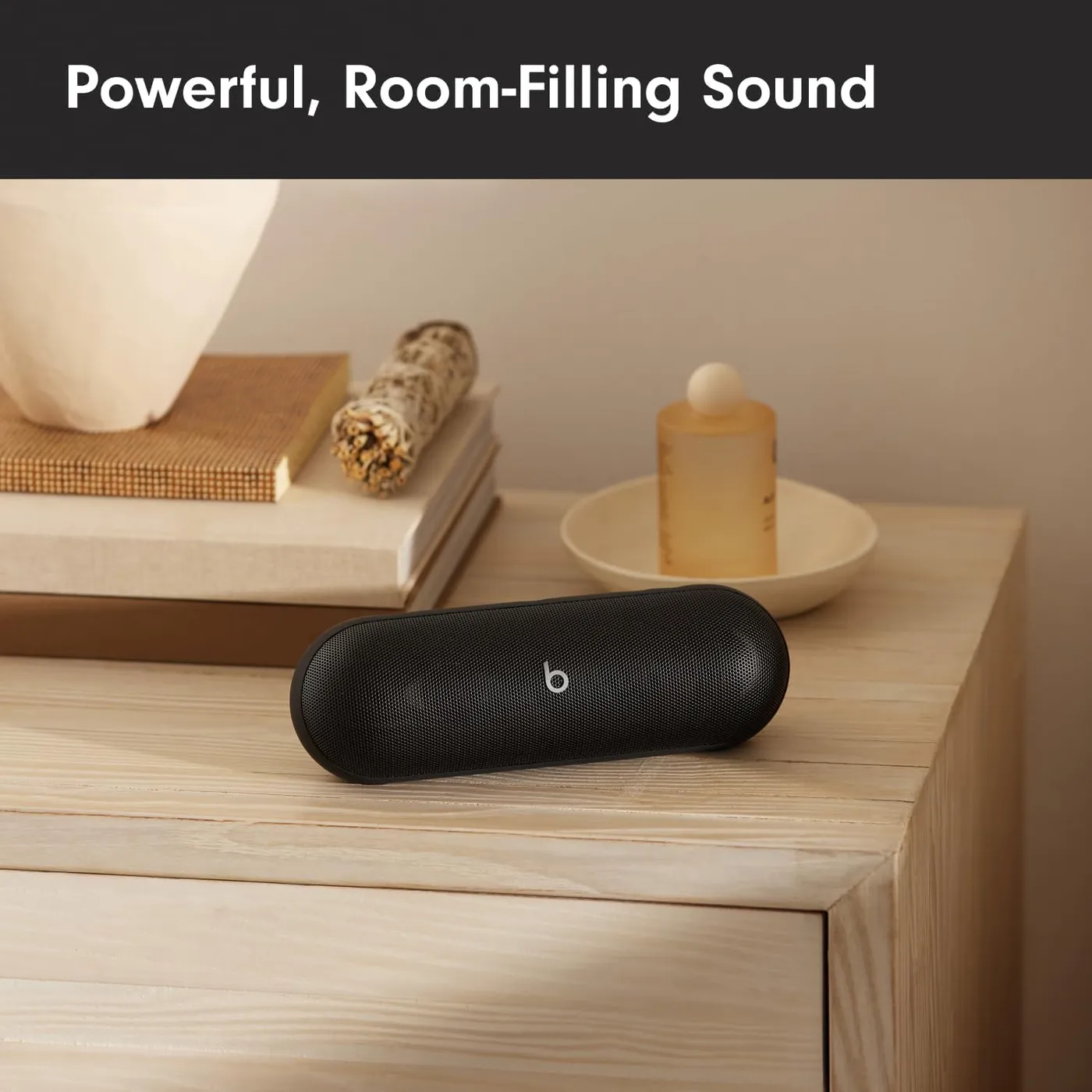
Audio is where the Beats Pill 2024 earns its goodwill. A redesigned racetrack woofer moves far more air than the old driver. The payoff is bass with real weight, from a speaker you can hold in one hand. It's the kind of low-end presence you usually pay much more to get. Across the bottom 60 percent of the dial, it sounds clean and full. That range covers where most people actually listen. Mids stay present. Highs are crisp without turning harsh. There's enough body down low to give tracks a real sense of scale.
The tuning is unapologetically bass-forward, though, and that's the core trade-off. Push past half volume, and the balance shifts. The low end starts to crowd the mids. On dense material, like heavy bass under deep male vocals, the sound can turn muddy. Outright distortion is rare. Still, clarity gives way to thump. Genre matters here. Hip-hop, pop, and electronic tracks thrive on this tuning. Acoustic and vocal-led music asks for more restraint than the Pill offers.
The harder issue is that you can't really fix it. There's no onboard equalizer. The Beats app offers no tone control either. So your only lever is whatever EQ your phone provides. Apple listeners can lean on the system EQ to tame the bass. Everyone else is mostly stuck with the house sound. If you listen at low to moderate levels, none of this will bother you. The compromise only shows itself when you push the speaker hard. As a single mono unit, it also won't produce true stereo on its own.
Design, build, and the controls
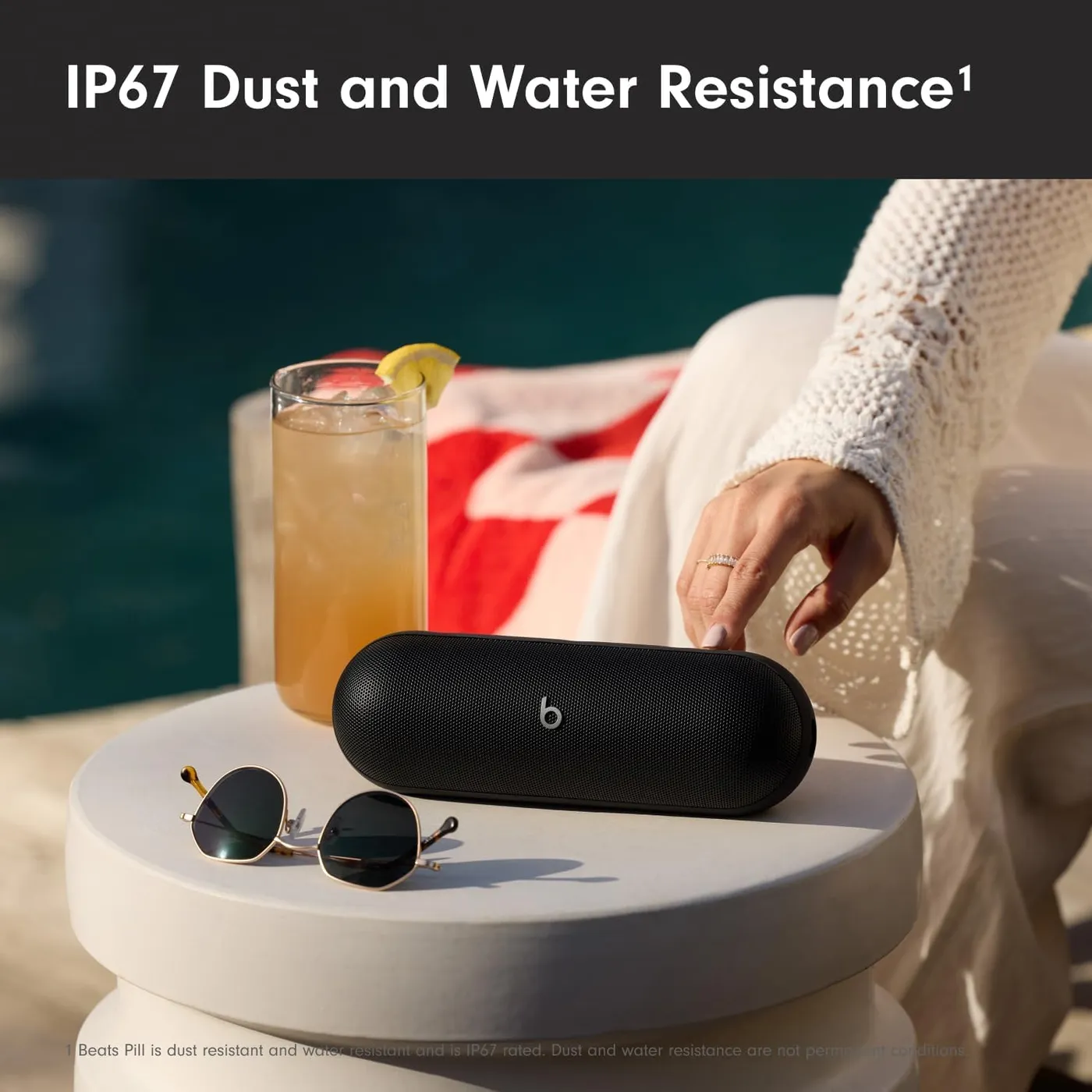
Build quality is a clear strength. The Pill feels dense and carefully assembled. A metal-mesh grille wraps the body, over a soft-grip silicone base. A removable lanyard clips to a bag or hangs off a hook. The unit carries an IP67 rating for dust and water resistance. In practice, that means it brushes off rain, splashes, and the odd poolside dunk. This is real protection, not just splash resistance on paper. The finish resists fingerprints and scuffs well, too.
Size is where the new model catches people off guard. This generation runs about two and a half times heavier than the slim first-gen Pill. The barrel is noticeably chunkier as well. It's still portable in any reasonable sense. But it's a backpack-and-house speaker, not a clip-to-your-belt-for-a-hike one. At this weight, it does stay put on a table instead of skittering around. So the heft has its upsides. Anyone upgrading from the featherweight original should reset expectations first.
Then there are the controls, the speaker's most avoidable weakness. Powering on or off takes a deliberate press-and-hold of one to two seconds. Hold too long, and nothing happens. The manual barely explains this. Figuring it out often means hunting down a how-to video. Worse, the speaker fires a loud, fixed-volume chime whenever it wakes or connects. You can't turn it down. It's startling enough to wake a quiet room. Once you internalize the timing, the buttons become muscle memory. The chime, however, never stops being intrusive.
Connectivity and Apple ecosystem fit
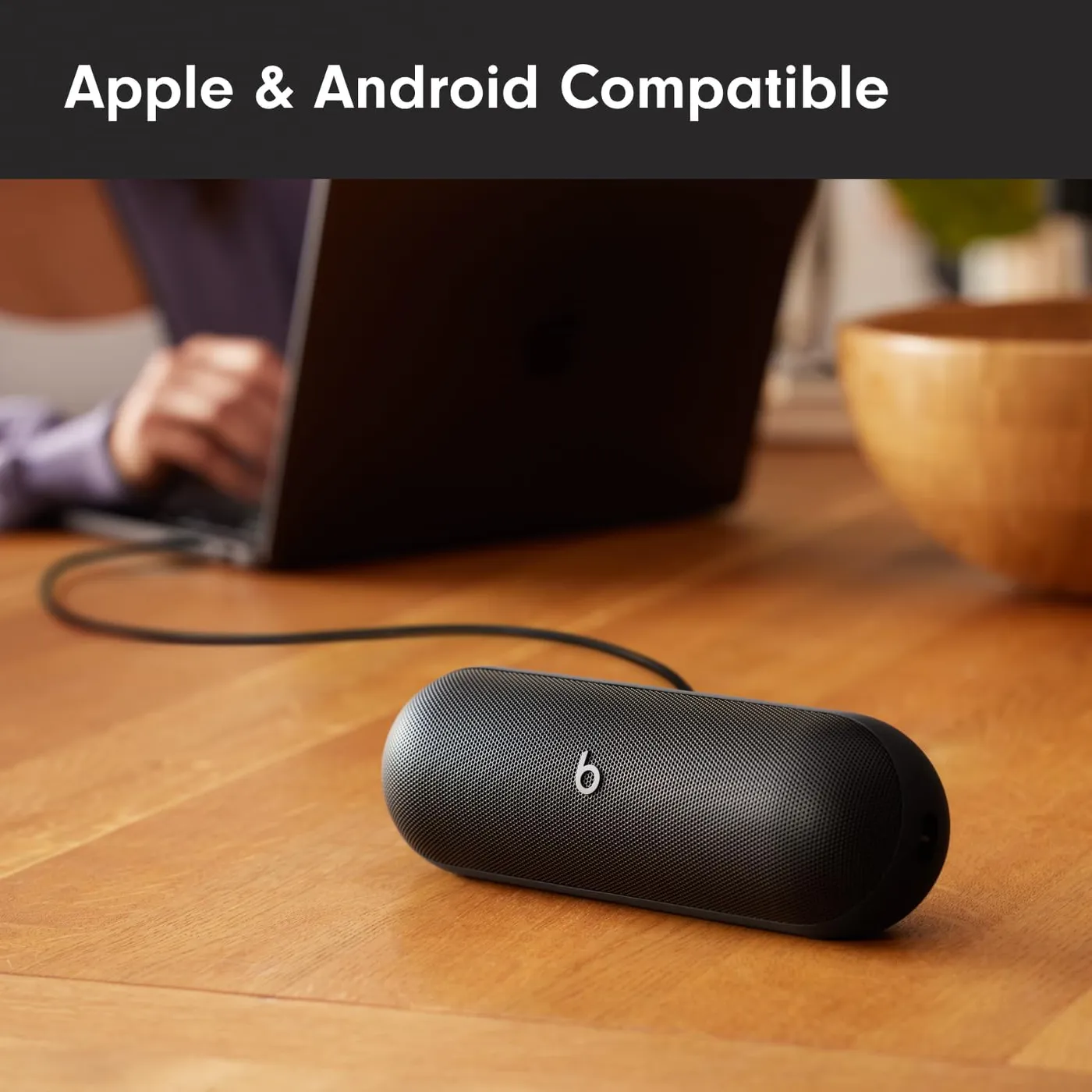
Connectivity is the Beats Pill 2024 at its best. On Apple devices, one-touch setup makes pairing nearly instant. The speaker also shows up in Find My, like an AirTag. So a misplaced unit is easy to track down. Switching playback between an iPhone, iPad, and Mac takes a single tap. It reconnects in about a second. That seamless handoff makes the speaker feel like part of the ecosystem, not a generic add-on.
Android owners aren't shut out, either. Standard pairing works fine, and the companion app runs on both platforms. Still, the marquee features are Apple-only. Instant pairing and Find My don't carry over. So the Pill makes the most sense inside the Apple world. Call quality through the built-in mic is serviceable for quick conversations. Hands-free use in the car is a common, practical scenario. It can also work as a wired USB-C speaker for lossless playback. Engaging that wired mode is fussier than it should be, though.
Range and stability hold up well across a typical home. When it works, and it usually does, the wireless experience is clean. A small number of units, however, develop persistent dropouts after months of use. Audio cuts out for seconds at a time. Sometimes even a full factory reset doesn't fix it. This is far from universal. But it shows up often enough to flag if you need absolute reliability.
Battery life and charging
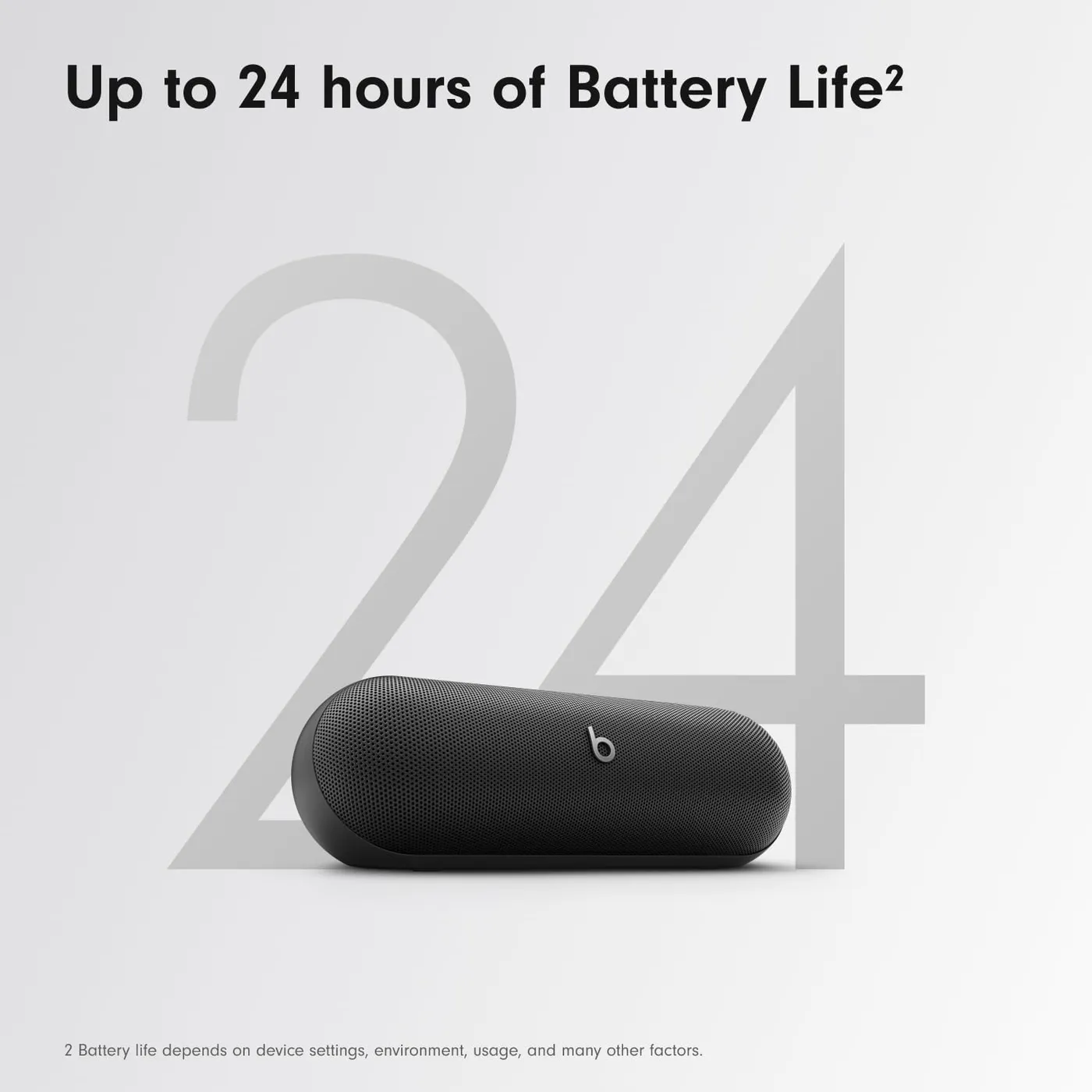
The headline spec is up to 24 hours of playback. That figure is technically real. But it holds only at low volume. Turn it up to party levels, and the battery drains far faster. Sustained loud playback can cut it to a fraction of the rating. Lower the volume a notch, though, and the gains are immediate. Battery life scales sharply with how hard you drive it. So read 24 hours as a best-case ceiling, not a promise for every session.
For everyday use at moderate volume, endurance is genuinely good. One charge comfortably covers a full work shift. It also handles a long afternoon outdoors. Battery health over time looks solid, too. The cell holds up across heavy daily use without obvious early degradation.
Charging runs over USB-C. A full charge from empty takes a couple of hours. There's no fast-charge headline here, but it's fine for an overnight top-up. In a pinch, the Pill can even reverse-charge a phone. That's a handy trick away from an outlet. The one nagging gripe is the accessories. The bundled cable is short, and there's no wall adapter in the box. So you'll likely supply your own brick.
Stereo pairing and Amplify mode
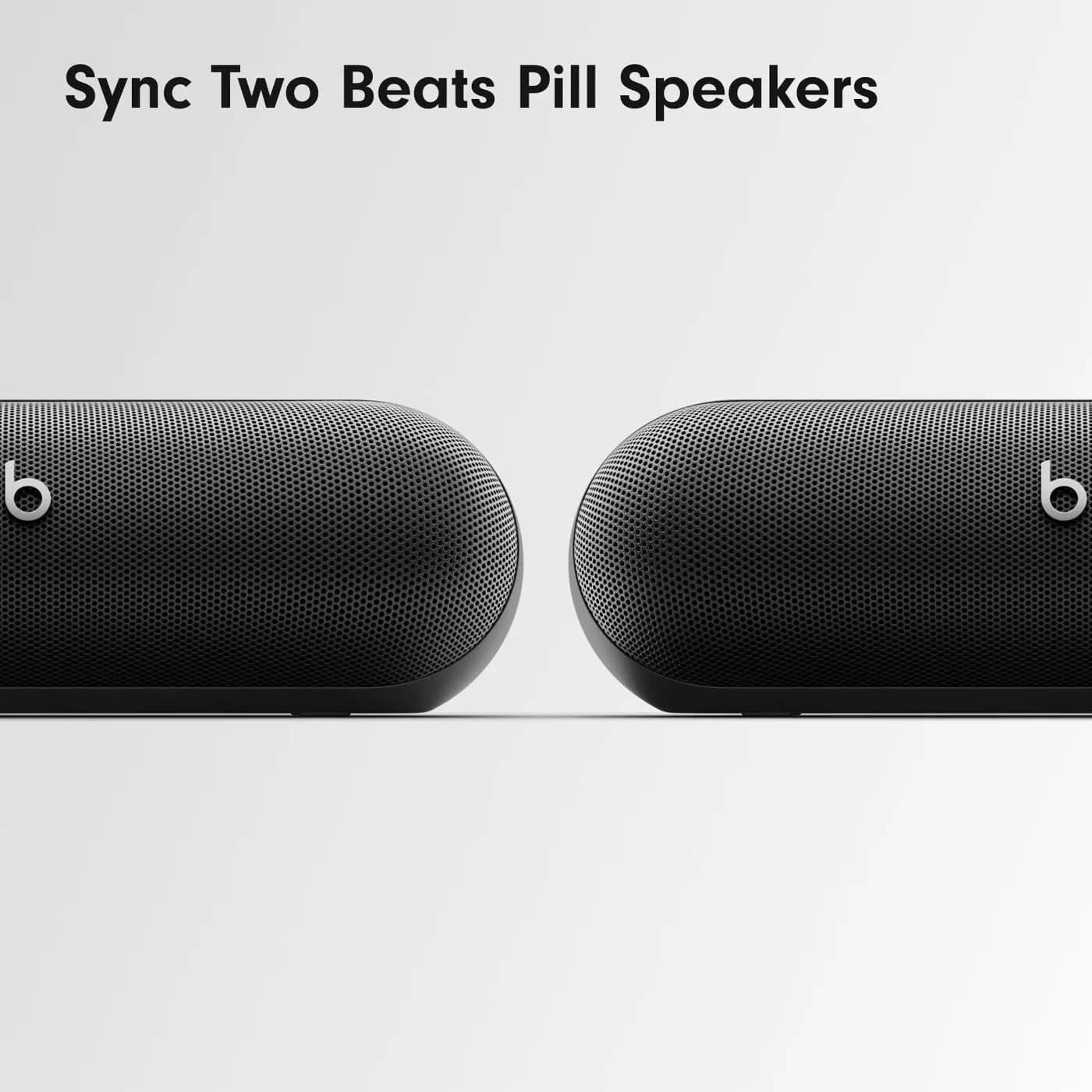
Add a second unit, and the Beats Pill 2024 transforms. Two paired speakers can run in Amplify mode, for one bigger, louder sound. Or they can run in true Stereo, for proper left and right channels. Either way, the jump in scale and imaging is dramatic. It's the best answer to the single-speaker mono limitation. The feature is built in, so no extra hub or subscription is required. A matched pair also unlocks the best-case soundstage, which one unit simply can't fake.
Setup isn't seamless, admittedly. Linking two units and getting stereo to stick can take several tries. That's especially true before a firmware update settles things. The same fixed power chime greets you on each speaker, too. Once it's dialed in, though, a stereo pair pulls ahead easily. It outperforms what a lone Pill can manage on its own. Two units do add cost and bulk, of course. For solo, casual use, a single speaker is plenty. The pair is for people who genuinely want room-filling sound at home.
Value and how it stacks up
Value is the most situational thing about this speaker. At full list price, it's a harder sell. You're paying a premium for the badge, the build, and the Apple integration. Brand loyalty carries real weight for some buyers, which is a legitimate reason to choose it. Just go in clear-eyed about the premium. Rivals like the JBL Charge 5 or Bose SoundLink Flex arguably do more on pure audio terms. The fixed, bass-heavy tuning and absent EQ also sting more at top dollar.
Catch it during one of its frequent sales, though, into the under-$100 range. At that point, the calculus flips entirely. You get weighty bass, a dependable moderate-volume battery, and IP67 toughness. You also get class-leading Apple convenience. It clearly outpunches most budget competitors there. Wait for the discount, and the speaker becomes easy to recommend. The takeaway is simple. Buy it on a deal, not at full retail.
Measured against the field, the Beats Pill 2024 is a lifestyle pick, not an audiophile one. The JBL options go louder outdoors and pack lighter for travel. The Bose tunes more neutrally and throws in a microphone. None of these rivals nails every category, though. Each makes its own compromise. What the Pill counters with is deeper bass and a more premium feel. It also has the tightest iPhone integration in the class. For the right listener, that's a trade well worth making.
Pros: What we liked
- Pro: Redesigned racetrack woofer delivers genuinely room-filling bass for a one-hand-sized speaker
- Pro: Up to 24 hours of playback at low volume, with a solid full-day showing at moderate levels
- Pro: USB-C charging plus reverse-charging to top up a phone in a pinch
- Pro: Best-in-class Apple integration: one-touch pairing, instant device switching, and Find My support
- Pro: IP67 dust and water resistance that handles rain and poolside use, not just light splashes
- Pro: Pairing two units for Amplify or true Stereo dramatically improves scale and imaging
Cons: What could be better
- Con: Power button is unintuitive – a precise press-and-hold that often takes several tries
- Con: Loud, fixed-volume startup and connect chime that can't be turned down
- Con: Bass-forward tuning with no onboard EQ; clarity slips past half volume
- Con: The 24-hour battery rating only holds at low volume; loud playback drains it quickly
- Con: Strong value only on sale – harder to justify at full list price
Best For
- Apple-ecosystem listeners who want one-touch pairing, Find My, and seamless device switching
- Listeners who love a big, bass-forward sound for rooms, backyards, and showers
- Bargain hunters willing to wait for one of its frequent sales
- Buyers who want a rugged, IP67 grab-and-go speaker that survives real-world use
Not Ideal For
- Detail-focused listeners who want neutral tuning and proper EQ control
- Anyone who needs to fill large outdoor spaces with a single speaker
- Buyers unwilling to watch for sales, since full-price value is weaker
| Specification | Details |
|---|---|
| Max Output Power | 69W |
| Audio Output Mode | Mono (single unit) |
| Battery Life | Up to 24 hours (low volume; far less when loud) |
| Charging | USB-C, with reverse charging to devices |
| Water/Dust Resistance | IP67 |
| Connectivity | Bluetooth, plus wired USB-C audio |
| Compatibility | Apple & Android; Find My support |
| Multi-Speaker | Amplify & true Stereo pairing (two units) |
| Colors | Matte Black, Champagne, Statement Red |
Alternatives Worth Considering
Final Verdict
The Beats Pill 2024 is easy to recommend, with one string attached: buy it on sale. When it dips into the under-$100 range, the package is hard to beat. You get weighty bass, a reliable moderate-volume battery, IP67 durability, and unmatched Apple convenience. The fixed tuning, fiddly controls, and loud chime are irritations, not dealbreakers. They're quirks you learn to work around. Do you live in the Apple ecosystem? Do you want a fun, loud, grab-and-go speaker more than a neutral, tweakable one? Then this is a strong pick at the right moment. Pay full retail, though, and the value argument gets thinner. For most buyers, the sweet spot is clear. Grab it on a sale, and enjoy.
Frequently Asked Questions
Does the Beats Pill 2024 really get 24 hours of battery life?
Only at low volume. At the louder levels most people actually use, expect substantially less – the 24-hour figure is a best-case ceiling, not an everyday number.
Does the Beats Pill have an equalizer or app to adjust the sound?
There's no onboard EQ, and the Beats app offers no tone control. Your only option is your phone's system EQ, which Apple devices handle best.
Can you pair two Beats Pill speakers together?
Yes. Two units run in Amplify mode for one bigger sound or true Stereo for left-right separation, and the upgrade in scale and imaging is significant.
Is the Beats Pill 2024 worth it over a JBL or Bose?
For Apple users wanting deep bass and tight integration, yes – especially on sale. The JBL plays louder outdoors and the Bose tunes more neutrally with a built-in mic.
Why does the speaker make a loud sound when turning on?
It plays a fixed-volume power and connect chime that can't be lowered. It's a known quirk and can be jarring in an otherwise quiet room.
The Verdict
A loud, bass-forward portable that's a genuine steal on sale - held back by clumsy power controls and a tuning you can't adjust.